Get Full Government Meeting Transcripts, Videos, & Alerts Forever!
Get email alerts on the Data Center topic
No spam. Unsubscribe anytime.
Residents tell Wythe County supervisors to weigh jobs against water and workforce concerns over proposed Progress Park data center
Summary
Multiple residents urged the Wythe County Board of Supervisors to scrutinize a proposed data center in Progress Park, raising questions about local water use (one speaker cited ~2,000 gallons/day), long-term job creation and AI-related risks; some asked the board to rescind a 2025 resolution welcoming data centers.
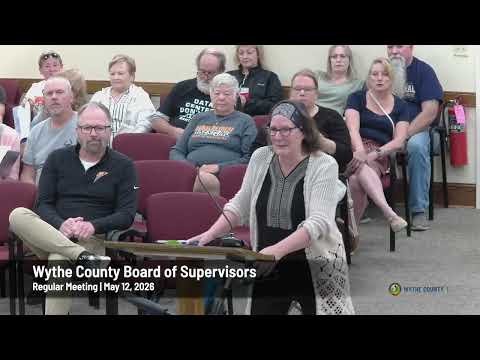
Public comment at the Wythe County Board of Supervisors' May 12 meeting focused on a proposed data center in Progress Park, with residents urging careful review of water use, local jobs and broader social impacts.
Several speakers raised specific concerns and comparisons. ‘‘As I understand it, this will be a closed-loop system, and the anticipated average daily water consumption will be approximately 2,000 gallons per day,’’ said Marcy Zahn, who told the board she has lived in the county since 2022 and urged the supervisors to be trusted to act in the community’s interest. Zahn compared the figure to water use at local businesses and recreation features to provide context.
Other commenters pressed the board on economic trade-offs. Sherry Burris said large, campus-style data centers can operate with ‘‘as few as 10 to 25 full-time workers’’ after construction, and warned that tax incentives and land devoted to server campuses can lock up resources that might otherwise support locally hiring industries. Her remarks urged investment in sectors that create stable, middle-class jobs in the county.
Andy Kegley asked the board to pursue a formal land‑use (zoning) ordinance that would allow the county to regulate ‘‘objectionable unwanted land uses’’ and to consider rescinding a January 2025 resolution that welcomed data centers to Wythe County. Jody Ward and other speakers emphasized economic development and the tax base, citing examples from other localities where incoming companies provided sizable school-system contributions during negotiations.
Concerns about artificial intelligence and broader social impacts also surfaced. Donna Nittster read a list of risks tied to AI (bias, privacy harms, loss of human judgment, deep fakes, loss of human control, employment disruption and extreme speculative risks tied to AGI), and said the board should consider those externalities even if a local moratorium is not feasible.
Board members and staff responded later in the meeting by pointing to technical details in project materials, noting the data center’s closed-loop cooling and its reported siting approximately a mile and a half from the nearest house. Supervisors said they wanted to protect the county and its children while also balancing potential economic benefits. Staff also noted public resources (a comprehensive plan map and state historic-resources mapping) that can inform siting and environmental review.
The board did not take a vote on the data center at the May 12 meeting. Several speakers urged additional public hearings and formal zoning tools to give the community a clearer, enforceable say in future land-use decisions.