Get Full Government Meeting Transcripts, Videos, & Alerts Forever!
Get email alerts on the Nealon Park Parking topic
No spam. Unsubscribe anytime.
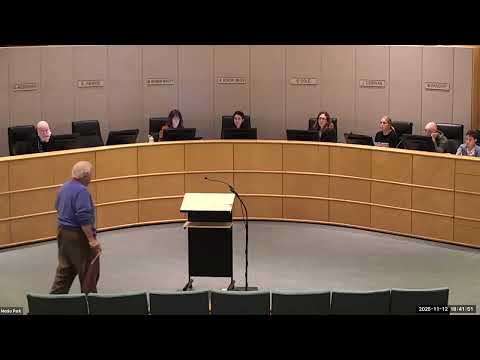
Menlo Park commission asks staff to develop design alternatives for Nealon Park frontage parking
Summary
After reviewing Nealon Park pilot results, the Complete Streets Commission asked staff to return with two or three design concepts (including a parallel-parking option and a reduced- or no-frontage/loading option), utilization data for the rear lot, and community outreach; the motion passed unanimously.
The Menlo Park Complete Streets Commission on Nov. 12 directed city staff to produce two to three design concepts for parking and bike-lane configuration along Middle Avenue in front of Nealon Park, asking staff to compare those options to the current back-end angled parking pilot and to return with data on rear-lot utilization and targeted community outreach.
Katrine Mackey, the city’s senior transportation planner, presented the history and evaluation of two pilots: the temporary closure of Blake Street to limit cut-through traffic and a sequence of parking pilots at Nealon Park that moved from 46 perpendicular spaces to a 14-space first pilot and then to a back-end angled configuration intended to restore capacity while improving sight lines.
Why it matters: commissioners said the fronting-parking design affects safety, school drop-offs and cyclist behavior at a location used by walkers (60% of survey respondents), cyclists and drivers. Staff emphasized the pilots’ goals were to improve pedestrian access to Nealon Park while balancing parking supply and safety for bicyclists.
Staff findings presented to the Commission included collision history, traffic volumes and a community survey. Mackey said collision reports tied to the park frontage were limited and that the flashing beacon, speed hump and new bike lanes installed as part of the Middle Avenue Complete Streets work have contributed to stable or slightly reduced 85th-percentile speeds on adjacent streets. The Commission heard that the city’s outreach survey (167 respondents) found mixed views on the back-end angled parking: 46% opposed, 31% supported and 24% uncertain; staff also reported 72% of the same survey supported making the Blake closure permanent (a separate pilot topic).
Public commenters emphasized competing needs. Lillian Mirzabegi, a parent at Menlo Atherton Cooperative Nursery School, said the earliest 14-space pilot was insufficient for regular drop-offs and pressed for parking that is “adequate and safe” and easy for families to use. Resident Jeff Piper, who lives on Blake Street, urged prioritizing pedestrian safety and said the survey data should be interpreted in context. Several speakers urged better signage and outreach to encourage use of the rear parking lot.
Commission debate centered on trade-offs: several commissioners said back-end angled parking improves driver sight lines when leaving a space and therefore may reduce conflicts with cyclists, while others said parallel parking with a bike lane behind parked cars had been perceived as safer for pedestrians and cyclists in earlier pilots and would be more familiar to nonlocal drivers. Commissioners also proposed intermediate options such as limited-time loading/drop-off spaces for preschool pick-ups, larger front spaces that alternate with buffers, or targeted design elements to better guide drivers to the rear lot.
Motion and next steps: Commissioner Matthew Raskoff moved—seconded by Commissioner Scott Hirscher—that staff return with two to three conceptual designs (examples discussed included a revised parallel-parking scheme that accounts for subsequent infrastructure changes and a reduced-frontage or loading-only option), utilization data for the rear lot and a plan for focused community engagement. The Commission approved the motion unanimously.
What staff will do next: Mackey said staff will produce illustrative designs, collect updated utilization counts for the rear lot, refine potential loading/drop-off rules and re-engage stakeholders (including the preschool and Little League) before returning to the Commission for a study session. The item will inform the five-year CIP discussions and any implementation steps.