Get Full Government Meeting Transcripts, Videos, & Alerts Forever!
Get email alerts on the Sustainable Aviation Fuel topic
No spam. Unsubscribe anytime.
Committee lays over bill to expand Minnesota sustainable aviation fuel tax credit with environmental guardrails
Summary
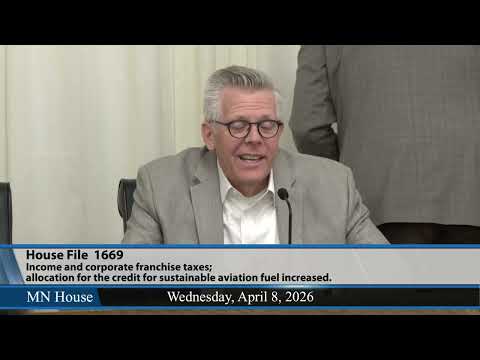
The House Taxes Committee heard bipartisan testimony supporting House File 16-69, which would expand Minnesota's sustainable aviation fuel (SAF) tax credit—boosting allocations, extending the sunset toward 2035 and adding guardrails to favor lower-carbon feedstocks and discourage land-use change. The bill was laid over for the tax omnibus.
House Taxes Committee members on the bipartisan panel heard several hours of testimony supporting House File 16-69 as amended, a measure to expand Minnesota's sustainable aviation fuel (SAF) tax credit and add environmental safeguards.
Tom Peterson, commissioner of the Minnesota Department of Agriculture, told the committee the amendment package increases annual allocations, extends the credit's sunset and adds qualifying requirements to prioritize lower-carbon-intensity fuels. "It also adds environmental guardrails," Peterson said, arguing the changes would help "maintain Minnesota's leadership in the sustainable aviation fuel world" and give companies "the certainty" to invest in local production.
A range of agriculture, forestry, clean-energy and labor witnesses described potential benefits. A farmer who identified himself as a vice president of Minnesota Farmers Union said winter-hardy oilseeds such as the varieties cited in testimony can provide continuous ground cover, new markets for growers and feedstock for SAF. "We feel like this is a win-win-win opportunity," he said.
Environmental groups supported the bill while urging the guardrails stay in place. Steve Morse of the Minnesota Environmental Partnership said the amendments—particularly language that limits land-use change and rewards lower carbon-intensity feedstocks—are central to ensuring SAF development also protects water and soil. Megan Anderson of Friends of the Mississippi River testified that the guardrails could help scale cover crops that improve water quality while supporting SAF feedstocks.
Industry and labor witnesses described imminent private investment and job potential if incentives are maintained. Testimony cited a recently announced production facility and described a project that could produce on the order of hundreds of millions of gallons per year; proponents said long-term certainty is necessary to attract additional plants and supply chains.
Committee members pressed witnesses on key risks: whether SAF demand could raise food prices if commodity feedstocks were diverted, how to ensure crops do not cause land-use change, and whether Minnesota risks losing investment to neighboring states that are also enacting incentives. Supporters said the bill's 51% life-cycle carbon-reduction standard and premium credits for low carbon-intensity pathways make it difficult for higher-impact feedstocks to qualify and that diversified feedstock strategies aim to avoid food-system impacts.
Chairpersons moved to lay House File 16-69 as amended over for possible inclusion in the House omnibus tax bill. The committee did not take a final floor vote on the merits; the bill was laid over with no further action recorded in the transcript.
What happens next: The bill will be considered for inclusion in the larger House tax package; sponsors and coalition partners said they will continue refining technical details and monitoring federal incentives that may affect project timelines.