Get Full Government Meeting Transcripts, Videos, & Alerts Forever!
Get email alerts on the School Safety topic
No spam. Unsubscribe anytime.
Senate committee advances $5,000 school‑safety package after debate over nonpublic funding
Summary
Senate File 5,000, a one‑time school safety aid and grant bill that would extend aid to charter and some nonpublic schools, was recommended to pass and referred to Finance after supporters and students urged action and senators debated whether nonpublic schools should receive per‑pupil aid or grants and what accountability safeguards are required.
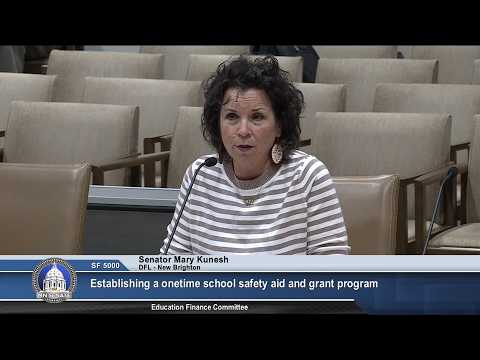
Senate File 5,000, presented to the Minnesota Senate Education Finance Committee on April 8, would provide one‑time per‑pupil school safety aid and a competitive grant program intended to reach traditional public, charter, tribal contract and some nonpublic schools. Chair and sponsor remarks framed the bill as a multi‑pronged response combining prevention, intervention, mental‑health services and physical‑safety upgrades.
Supporters who testified included students and representatives of school boards, charter‑school associations and nonprofit child‑advocacy groups. "When children feel safe and supported, they can learn," said Alexander Fitzsimmons, senior policy director at the Children's Defense Fund–Minnesota, urging inclusion of flexible uses that extend beyond hardening schools to building belonging and outreach to chronically absent students. Charter‑school groups—including the Minnesota Association of Charter Schools—asked the committee to include charter schools in eligibility because charters currently lack dedicated safety revenue and must use classroom funds for safety measures.
Several students described lockdowns and fear at school. "We’re very concerned for our safety, and it's something I think about every day," a student who identified himself as Landon told the committee. Other testifiers from charter and independent schools described needed upgrades such as protective window film, upgraded communications systems and emergency door locking systems and urged that grants prioritize schools with lower fiscal capacity.
Education Minnesota opposed language in the bill that would provide grants to nonpublic schools without stronger accountability and nondiscrimination requirements. Kaitlin Snider, representing Education Minnesota, said public funding for private schools raises questions about exclusionary admission policies and audit transparency and urged caution.
Committee debate centered on whether to convert the nonpublic grant category to a per‑pupil aid for FY 2027 and whether nonpublic recipients should be held to the same statutory requirements as public and tribal contract schools. Senator Holmes offered an amendment to provide nonpublic schools a per‑pupil allocation instead of a competitive grant; the amendment was printed, discussed, called for a roll‑call vote and failed in committee (the chair announced the amendment did not pass). Members argued both legal and equity points: some cited the Minnesota Constitution and precedent about prioritizing public schools, while others argued courts have upheld targeted public funding to cover student safety and transportation regardless of school governance.
After extended debate, the committee voted to recommend SF 5,000 pass and referred it to the Finance Committee for consideration in the omnibus process. Committee members emphasized the bill was intended as a one‑time, flexible investment in both physical upgrades and student supports intended to prevent absenteeism and address trauma. The committee did not finalize appropriation amounts or enact the bill; further details will be set in the Finance Committee and the omnibus package.
Next steps: SF 5,000 was recommended to pass and referred to the Senate Finance Committee; stakeholders should monitor appropriations and any conforming language or accountability requirements that may be added in subsequent committee work.