Get Full Government Meeting Transcripts, Videos, & Alerts Forever!
Get email alerts on the Family Residential Services topic
No spam. Unsubscribe anytime.
Providers, families warn Senate committee that flat FRS rate risks closing homes
Summary
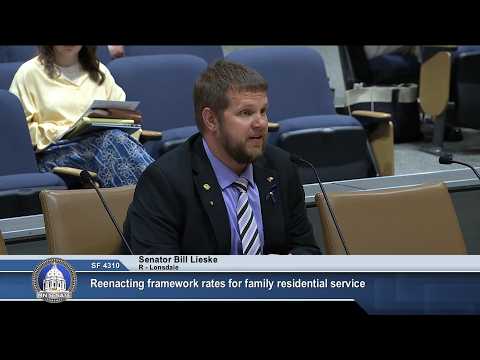
Providers and family members told the Human Services Committee that applying a flat per‑person rate to family residential services (FRS) would shift costs onto families, force closures of small homes and reduce choice for people on waivers; the bill (SF4310) would preserve FRS under its prior rate approach while lawmakers seek clearer fiscal data and tier definitions.
Senate File 4310 drew emotional testimony as providers, guardians and families urged the Human Services Committee to reject—or amend—efforts that replace individualized FRS payment with a flat per‑person rate.
"This is not about policy. It's about rights," said Angela Stressor, identifying herself as a residential service provider and advocate, as she asked lawmakers to preserve service recipients’ right to choose where they live and who supports them. Stressor explained that adult foster care (AFC) operates as a relatively uniform setting, while family residential services are individualized, medically and behaviorally driven, and therefore depend on acuity‑based funding.
Family members also took the floor. "The flat rate does not allow providers to provide the adequate care that [my cousin] needs and to pay the employees the wages they deserve," said Evan O'Connor, who described how his cousin prospered in an FRS setting and urged restoring the prior FRS rate methodology.
Small home providers echoed those concerns. Julie Stankey, owner of Julie Michael's Adult Foster Care, told the committee: "Your system is failing," and described provider letters and reports in the packet that, she said, document closures, data problems and the real‑world impacts on people who would lose stable homes.
Committee members pressed for numbers and asked staff for fiscal detail and distributional analyses. Members discussed how tiered rates—presented as a multi‑tier model ranging roughly from $195 to $383 per day in the department's materials—would produce winners and losers depending on current placements and how individuals are assigned to tiers. Several senators asked for precise fiscal notes, noted that the state share of FRS/related programs totals in the hundreds of millions of dollars, and requested modeling showing phase‑in impacts and whether reductions would shift costs into corporate residential settings.
The committee did not take a final vote on SF4310 at the hearing. Senators repeatedly asked department staff and fiscal experts to return with clearer spreadsheets and service‑agreement timing for when providers and families will know exact new rates.
What happens next: SF4310 was laid over for further work and possible inclusion; committee members asked for detailed fiscal modeling, tier distribution data, and an assessment of likely provider closures under the proposed rate methodology.