Get Full Government Meeting Transcripts, Videos, & Alerts Forever!
Get email alerts on the Healthcare Policy Prefunded Fsas topic
No spam. Unsubscribe anytime.
Sen. Bill Cassidy urges converting enhanced premium tax credits into prefunded patient-controlled FSAs
Summary
Sen. Bill Cassidy proposed redirecting the COVID-era enhanced premium tax credit into prefunded flexible spending accounts that patients control, saying the change would send more dollars to care, reduce insurer administrative take, and create incentives to lower health-care costs.
Sen. Bill Cassidy, chairman of the Senate Committee on Health, Education, Labor, and Pensions, proposed converting the enhanced premium tax credit into prefunded flexible spending accounts that patients would control, saying the change would shift funds from insurers to direct care and create incentives to reduce health-care prices.
Cassidy said the nation faces a clear problem with the affordability of health care and health insurance and drew on more than two decades practicing medicine in a public hospital for the uninsured to explain his approach. "We should give the patient the power," he said, arguing that the current COVID-era enhanced premium tax credit (which he described as a later addition to the original 2010 Affordable Care Act tax credits) sends billions to insurers and weakens pressure to lower providers' prices.
Cassidy framed the proposal as narrowly targeted: it would not change the baseline tax credit enacted under the Affordable Care Act in 2010 that helps people under 400% of the federal poverty level, he said, but would repurpose the enhanced premium tax credit dollars created during the pandemic. He said roughly $26 billion in enhanced credits could be redirected and that "20% of the $26 billion we send them next year goes to profit and administrative overhead." Under Cassidy's plan, he said, "100% of the $26 billion would go to the real care that that woman and her family needs." He listed services patients could buy from those accounts, including physician visits, dental care, prescriptions, eyeglasses and orthodontia.
On mechanics and feasibility, Cassidy said flexible spending accounts are already common in the federal workforce and private employer plans and pointed to a similar program used by Indiana in its Medicaid population. "This is not so complicated," he said, noting that federal systems that administer FSAs for some employees and small employers could be adapted to enroll people in the individual insurance exchange.
Cassidy acknowledged implementation questions but said the transition could be done without touching the 2010 baseline credits. He also spoke to likely cost timing: the first year of the conversion would cost about the same as current enhanced premium credits because reforms that lower underlying health-care prices will take time to produce savings, he said, adding that those reforms could begin to reduce costs by 2027.
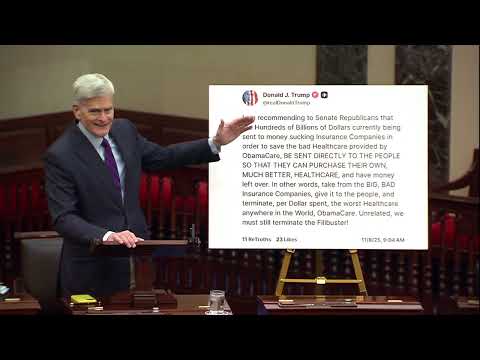
Cassidy cited political advantages as well, saying President Donald Trump publicly endorsed the idea on social media and urging Speaker Johnson to bring the proposal to a House vote. He called for bipartisan consideration rather than reflexive opposition to proposals based on partisan authorship.
The proposal outlined by Cassidy in this floor speech is a policy concept rather than a bill enacted by the Senate; he urged colleagues to consider the idea ahead of upcoming votes on health-care costs.