Get Full Government Meeting Transcripts, Videos, & Alerts Forever!
Get email alerts on the Economic Development topic
No spam. Unsubscribe anytime.
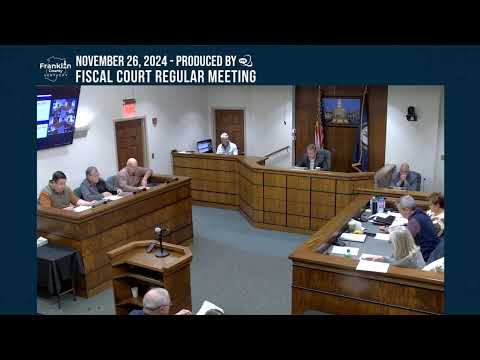
Fiscal Court approves interlocal agreement to create Keaton Lane industrial authority after heated public comment
Summary
After more than two hours of public comment—largely opposing a proposed industrial park—the Franklin County Fiscal Court voted to approve an interlocal agreement creating the Keaton Lane Industrial Development Authority so the region can apply for a state PDI grant, with county officials and residents sharply divided over transparency, land loss and local control.
Franklin County’s Fiscal Court voted Nov. 26 to authorize an interlocal agreement that establishes the Keaton Lane Industrial Development Authority and allows the authority to apply for state PDI (Prepared/Ready Industrial) grant funding, despite sustained public objection from residents living near the proposed site.
The action, approved by a majority of the court after an extended legal briefing and line-by-line questions, enables the multi-jurisdictional authority to pursue grant funding the county cannot access on its own. Supporters on the court said the move preserves the county’s ability to seek jobs and tax revenue; opponents said the process was rushed and would risk farmland and local control.
The vote followed a 60‑minute public-comment period in which multiple speakers—largely property owners and farmers who live adjacent to the proposed project corridor—pleaded with the court to delay or reject the agreement. John Carlton, a resident who opened public comment, said the process had been opaque and warned that a lack of transparency “undermines public trust.” Katie Jones, whose property borders the proposed site, said an industrial park would bring “light pollution, noise pollution, traffic” and irreversibly change the rural character of the area.
County counsel Gil Johnson told the court the interlocal agreement itself does not authorize construction or rezoning. Instead, it creates a regional authority that can apply for and, if awarded, administer a PDI grant with matching funds and carry out permitted economic‑development activities within the legal project area. Johnson said some edits were made to the draft at the request of the city partners to remove language about unspecified “future projects” and to insert the legal description of parcels currently under option.
Several magistrates pressed Johnson and economic-development staff on governance details: how authority board members will be appointed, whether the authority could change project boundaries by purchasing contiguous parcels, what approvals would be required before any public funds are spent, and whether the authority could obligate local revenues. Johnson said the authority’s actions that require county funding would still be subject to the county’s appropriations process and local zoning review remains the prerogative of the county planning and zoning process.
Supporters on the court said the county retains multiple controls—zoning, appropriations, and tax incentives—and that rejecting the interlocal would foreclose an opportunity to assemble a grant-eligible megasite. “Voting no on this resolution stops it and gives us no other options,” said one magistrate in favor. Opponents said those assurances were insufficient and signaled they would continue to press for transparency and for alternatives that protect prime farmland.
Judge Muller (the county judge/executive) and staff noted that the interlocal and an accompanying resolution naming Franklin County as the grant recipient would be filed with the state Cabinet for Economic Development and the Department for Local Government; project eligibility guidance recommends assembling at least ~350 contiguous acres, the county’s economic-development staff said. County staff emphasized that any PDI grant would be subject to match rules and subsequent budgetary approval by the Fiscal Court.
The court also voted on a set of related, routine items during its session—awarding bids for road equipment, approving a scope-of-work for a Safe Streets and Roads for All (SS4A) safety plan, and authorizing purchases for parks and facilities—but the interlocal agreement drew the most public attention and divided votes from elected officials.
The resolution passed by majority vote following roll call. The court did not adopt final development approvals; any rezoning, infrastructure appropriations or incentive agreements would require separate, subsequent approvals by the court and by planning and zoning processes.
What’s next: Franklin County staff will file the interlocal and a county resolution naming the county as grantee with the Department for Local Government and the Cabinet for Economic Development as part of a PDI grant application package. If the county is awarded PDI funding, any spending of county-appropriated funds would return to the Fiscal Court for formal appropriation.