Get Full Government Meeting Transcripts, Videos, & Alerts Forever!
Get email alerts on the Amphitheater Proposal topic
No spam. Unsubscribe anytime.
Washington officials, residents split over proposed $12 million D Amphitheater; council requests town hall and more study
Summary
A proposed $12 million privately funded amphitheater prompted lengthy public comment and council debate on Feb. 10; residents raised noise and financial-risk concerns, the HST Foundation and its consultants defended the project’s model, and council members voted informally to hold a town hall and to require more analysis before any binding step.
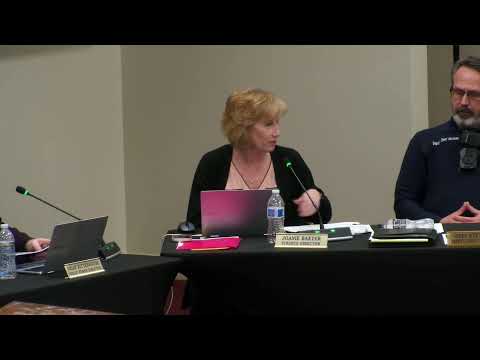
The City of Washington’s Committee of the Whole spent most of its Feb. 10 meeting on the HST Foundation’s proposal to build a $12 million D Amphitheater on the city-owned 223-acre parcel, with residents, foundation representatives and city staff offering sharply different views on noise, economics and next steps.
Supporters who spoke during public comment praised the private gift and the potential for new visitors and local spending. “I am in favor of the amphitheater—when has Washington … been gifted a $12 million value donation?” resident Mark Bar said, asking also whether the city attorney’s opinion on a possible mayoral conflict would be made public. Several nearby residents urged a pause and an independent acoustical review before any council approval. “We request the city engage an independent sound expert to review the sound attenuation plans,” resident Robin Han told the council, adding that the foundation-funded study and staff memo left unanswered questions about topography and neighborhood impacts.
Representatives of the HST Foundation answered those concerns in a joint presentation. Bob Brown, who read a letter from the foundation, said the foundation “will build, manage and operate the D Amphitheater, placing no financial burden of any substantial kind on the city of Washington,” and noted contingency funds and an endowment effort. Nick Leroy, the foundation’s acting director of entertainment, described his promotion experience and told the council the proposed 5,000-seat D would serve a broader regional market than the city’s 1,100-seat Five Points theater. “Most ticketed events are supported 70 to 80% by people who come from 50 miles or further away,” Leroy said, arguing the venue would attract nonlocal visitors and spend to area hotels and restaurants.
Project engineer Kevin Graham and the foundation’s acoustic consultants described the study that informed the feasibility report and explained the next design phase. They said the initial model estimated unattenuated sound levels from a center-of-stage projection and that the design team will run on-site ambient measurements, 3-D acoustic simulations, seating orientation adjustments, berms and vegetation, directional speaker arrays and contract language with performers and promoters to reduce off-site sound. “We will be conducting a noise model to analyze amplified sound, the orientation and the terrain,” Kevin Graham said, adding that the team will “optimize the modeling and refine that in the design process to make sure that we are adhering to the sound codes.”
Several aldermen and other speakers said the presentations and the feasibility study left too many open questions. Alderman Blundy gave a detailed critique of the financial analysis and said he would not support any letter of intent (LOI) or city commitment unless two conditions were met: the project must not be a financial burden on taxpayers, and it must not be a nuisance to nearby residents. Blundy questioned revenue inputs that used comparables for much larger facilities, asked for sensitivity analyses, and flagged the city’s municipal noise ordinance (section 3-36-5) as written for a different scale of activity.
Multiple council members asked that the foundation submit any LOI to the city attorney for review before discussion at a public meeting. Staff confirmed it expected to receive the LOI and that typical LOIs are non-binding; city staff also said they would bring any LOI to a future council meeting for public discussion and legal review.
On process, the council used two informal straw polls during the Committee of the Whole. The first straw poll, requested at the meeting’s opening, asked whether members favored postponing any binding decision until after the new council is seated in May; council members expressed mixed views. Later the council took a non-binding straw poll in favor of holding a town-hall meeting so residents’ questions could be asked and answered publicly; that straw poll passed by informal assent and staff was directed to schedule a town hall.
What happens next: staff and the foundation signaled they will continue with design-phase work and further analysis; the council asked for an independent review of noise modeling and for a clearer, itemized breakdown of projected city costs and contingency plans for years when the foundation’s support may change. Several aldermen repeated that they would not support an LOI or any binding action until the outstanding financial and acoustic questions are resolved. The Committee of the Whole adjourned after the petitions collected from residents were turned in for the record.
The council is expected to hold the requested town hall and to place any subsequent LOI, contract or binding action on a public City Council agenda after legal review and after staff returns with the additional analysis and documentation requested by members.