Get Full Government Meeting Transcripts, Videos, & Alerts Forever!
Get email alerts on the Noise Ordinance topic
No spam. Unsubscribe anytime.
City attorney warns legal risks as Freeport council debates 7 a.m.–7 p.m. construction hours
Summary
Councilmembers began a detailed discussion about adopting construction-hour limits (a proposed 7 a.m.–7 p.m. window) to reduce early-morning disturbance for elderly and disabled residents; the city attorney cautioned enforcement will be legally complicated without calibrated noise studies and equipment.
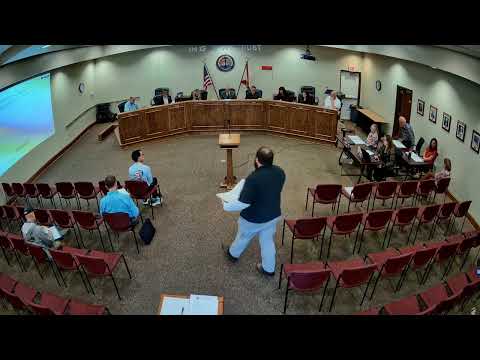
Council members opened a lengthy debate on Oct. 14 about whether to adopt construction-hour limits after multiple residents complained about early-morning work that wakes elderly and disabled neighbors.
Councilwoman Hurst introduced the item, saying the city currently has no noise ordinance and proposing a 7 a.m.–7 p.m. construction window to reduce disturbances. "We do not have a noise ordinance," she said, adding the restriction would "keep people from waking up everyone" and still allow contractors a 12-hour workday.
The city attorney warned the council that recent case law in Florida has left municipalities in a legally uncertain position. He said courts have found language such as "plainly audible" problematic and that effective enforcement typically requires calibrated decibel meters and a defensible study of ambient background noise. "Unless you have law enforcement or code enforcement with decibel meters and an established study establishing the ambient background noise, it's not going to be upheld," he said, urging careful drafting to avoid unintentionally penalizing routine homeowner activity.
Council members raised practical concerns about enforcement and exceptions. One member asked whether deputies could respond to disturbance calls and enforce a city ordinance; the attorney answered that deputies could be called but he would not expect the sheriff to proactively enforce local construction-hour rules and recommended using code officers for initial responses and written notices.
Members also stressed that some commercial projects require nonstandard hours—for example, concrete pours that must happen overnight—and asked staff to include a mechanism for foreseeable exceptions or special permits so essential work would not be disrupted.
The council did not adopt an ordinance at the meeting. Staff were asked to draft ordinance language that reflects: the council's proposed hours, a clear linkage to "construction" activity (to avoid capturing routine homeowner tasks such as lawn mowing), enforcement procedures that start with code-officer notices, and a process for permitting necessary exceptions.
The discussion is expected to return to the council for further consideration after staff provide draft language and a recommended enforcement approach.