Get Full Government Meeting Transcripts, Videos, & Alerts Forever!
Get email alerts on the Data Centers Transmission Costs topic
No spam. Unsubscribe anytime.
Virginia subcommittee delays data-center transmission bills, asks SEC review after bipartisan debate
Summary
A Senate Commerce and Labor subcommittee carried over a bill on undergrounding and transmission-cost allocation to 2027 and tabled a separate measure requiring SEC review of very large electric loads, after testimony from environmental groups, utilities and labor about who should pay for transmission projects serving data centers.
A Virginia Senate Commerce and Labor subcommittee on an unspecified date delayed action on multiple bills aimed at addressing the transmission costs tied to data centers, carrying one measure over to 2027 and tabling another while asking the State Corporation Commission (SEC) to review the broader issue.
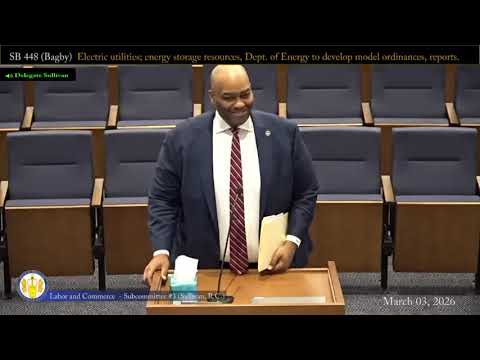
The committee voted to carry SB 339 (voice vote) to 2027 after extended debate over how to allocate the large transmission projects that have accompanied recent data-center buildout. Sponsor remarks and public testimony centered on two competing claims: advocates and some localities said ratepayers should not absorb the full cost of transmission lines built to serve data centers, while industry representatives urged the SEC’s ongoing work would address cost-allocation questions.
Senator Perry, the bill sponsor, described a suite of measures including a proposal that would allow qualifying localities in specific planning districts to tax large energy users to pay for undergrounding transmission lines, while explicitly protecting residential ratepayers from being charged for those costs. He said the bill limits its scope geographically and aims to “protect the ratepayer” by preventing costs driven by large new loads from being passed to ordinary customers.
The proposal prompted questions from committee members about who ultimately pays for undergrounding and whether neighboring localities must coordinate levies. Perry said the bill applies to particular planning districts and leaves discretion to localities about whether they impose a targeted charge on large energy users.
Clean Virginia’s Laura Gonzalez told the panel the cost impact is already measurable: "Dominion Energy recognized that the utility has spent $2.4 billion on transmission lines to exclusively serve data centers," she said, arguing that without legislative action "residential and other customers will also have to pay for this cost." Industry witnesses pushed back. Nicole Riley of the Data Center Coalition said the sector is "committed to paying our full cost of service" and argued the utilities and the SEC have mechanisms in place to study and address cost allocation in upcoming cases.
Labor and construction-trade witnesses warned of economic consequences if the state curtailed the industry; Jason Park and Lou Spencer of the building trades said restrictive changes could undermine local economic benefits tied to data-center development. Others, including representatives of electric cooperatives and legacy industrial customers, expressed conditional support for technical amendments and opt-out protections.
Separately, the panel considered SB 619, a DLS-prepared substitute that would raise the threshold for a "high-load facility" to 90 megawatts and require a certificate of operation from the SEC for very large new electric loads. The sponsor framed that bill as a state-level review to assess impacts on grid reliability, environmental and public health concerns, and the potential for cross-subsidization of costs to other customers.
After public comment — including a citizen who warned that recent SEC approvals of gas plants undercut the Virginia Clean Economy Act — the committee voted 9–0 to table SB 619 and requested that the chair send a letter to the SEC asking it to evaluate the issues raised by the bills.
The committee’s actions leave substantive policy questions pending: whether the Legislature should authorize local levies on large energy users, how the SEC should weigh certificate-of-operation requests for very large loads, and how to ensure cost-allocation changes do not shift burdens to residential customers. The subcommittee adjourned after recording the votes and thanking participants.
The committee carried SB 339 over to 2027 by voice vote and tabled SB 619 on a 9–0 recorded vote. Further legislative steps or SEC action were not specified at the hearing.