Get Full Government Meeting Transcripts, Videos, & Alerts Forever!
Get email alerts on the Child Care Investigation Disclosure topic
No spam. Unsubscribe anytime.
Minn. committee pauses bill to require agencies to disclose when child-care investigations are under way after heated testimony
Summary
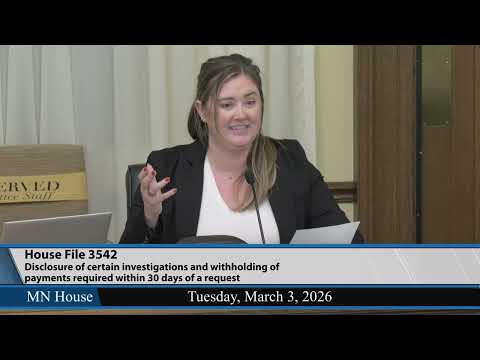
Lawmakers debated House File 3542, which would require agencies to disclose the existence of investigations into providers after payments are reduced, suspended or withheld; child-care providers testified about threats and harassment, the inspector general warned of interference risks, and a motion to re-refer the bill failed so the item was laid over.
Representative Hudson introduced House File 3542, saying the bill would require state agencies to disclose, on request, that an investigation into a taxpayer-funded provider is under way once the agency has notified the subject and decided to reduce, suspend or withhold payments. "We are not talking about targeting child cares as a category," Hudson said, arguing the public and legislators deserve transparency about how public dollars are being used.
The measure drew emotional public testimony from multiple child-care providers who said public disclosure would expose them to harassment and danger. "Please stop criminalizing childcare providers," Maria Snyder, a St. Paul child-care provider, told the committee, describing a recent episode in which a truck circled her building and someone defecated at the entrance. Snyder said an audit produced a 5% error rate and a resulting fine, and she urged lawmakers not to publish names before investigations conclude.
Claire Sanford of the Minnesota Child Care Association described a chilling effect on providers speaking to the press: "I've spoken with so many providers who have received threats, voicemail threats, threats emailed to their homes. They say they can't speak to the media anymore." Testimony from other providers recounted enrollment drops and persistent intimidation after viral videos and outside investigations.
Inspector General Keys told the committee the office uses records, error rates and patterns of repeated mistakes to distinguish clerical errors from problems that merit stopping payments. He warned that early public disclosure could "interfere with our work" by encouraging vigilante behavior and making it harder to investigate. "This doesn't help me in any way," he said, explaining that the inspector general sometimes stops payments on a lower administrative threshold than criminal fraud and must follow up with an investigation.
Lawmakers split along familiar fault lines between transparency and protection. Some members said the public and the legislature need information to exercise oversight; others said disclosure before a final finding risks reputational harm and real threats to providers. Several members suggested working with the inspector general to add a buffer or clearer limits to the proposed disclosure timeline.
The committee took a roll-call motion to re-refer HF3542 to the Human Services Committee; the clerk recorded seven members voting in favor, but the motion "did not prevail," and the chair announced HF3542 would be laid over for further work.
The committee left the issue open for additional stakeholder negotiation, with members on both sides saying they want to refine language that protects investigations while limiting the risk of public harm.