Get Full Government Meeting Transcripts, Videos, & Alerts Forever!
Get email alerts on the Property Tax Revaluation topic
No spam. Unsubscribe anytime.
Greenwich revaluation lifts 2025 grand list about 25%; assessor cites housing squeeze and new veterans exemption
Summary
Town Assessor Lauren Elliot told the committee the 2025 revaluation raised Greenwich’s grand list by roughly 25%, lifting total assessed value to about $46.3 billion; motor-vehicle valuation changes and a new state exemption for 100% disabled veterans helped drive category shifts. Final appeals reductions will be set after the Board of Assessment Appeals meets in March.
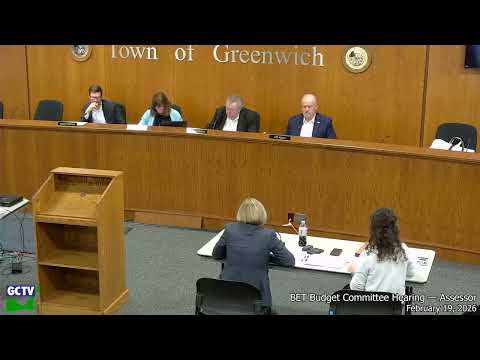
Town Assessor Lauren Elliot told the committee on Feb. 4 that the Town of Greenwich’s 2025 revaluation produced an estimated roughly 25% increase in the grand list, raising total assessed value to about $46.3 billion.
Elliot said residential properties remain the dominant share of the town’s tax base, rising from about $29 billion to $38 billion and representing roughly 82% of the grand list. Commercial assessments grew too but by a smaller margin; she said commercial value represents about 18% of the total.
“Since the last time we did a revaluation, which was back in 2021, the real estate market has done nothing but increase,” Elliot said, noting low inventory—about 88 listings on the MLS as of Feb. 4—has contributed to continued price appreciation and competitive bidding on listings.
The assessor identified several specific drivers of the change. A recent state law now requires municipalities to exempt the dwelling of veterans who are 100% disabled; Elliot said roughly 14 veterans in Greenwich qualified, which raised real-estate exemptions from about $9.5 million to roughly $18 million. She emphasized the exemption applies to the dwelling, not the land.
Elliot also discussed a statutory change in motor-vehicle valuation that uses manufacturers’ suggested retail price (MSRP) as the base. She said that change reduced assessed values for some older or collectible vehicles that had previously been assessed on used‑retail averages, while overall motor-vehicle values rose about 5.3% this year.
“Once we have an MSRP for a motor vehicle, it stays the same as long as the person owns the motor vehicle,” Elliot said, describing the shift in methodology and its mixed effects across different vehicle types.
Elliot presented other details used in the revaluation process: building permits pulled between Oct. 1 and Sept. 30 feed the October 1 grand list, and the assessor’s office supplements permit data with MLS listings and in‑person inspections. She said the office annually measures roughly 2,000–3,000 parcels so it does not have to ‘measure and list’ every parcel in a single year. The current revaluation work was roughly $810,000, Elliot said, covering consultants, data quality and notice printing.
On statistical performance, Elliot said the town’s overall assessment‑to‑sale ratio is near 92% and the coefficient of dispersion (COD) is under 10—figures she described as meeting or exceeding state expectations (state guidance targets a COD under 15). She said waterfront, district and condominium submarkets were all analyzed separately; condos showed a larger percentage increase (about 35%), and waterfront districts rose about 28%.
Elliot cautioned that the grand list figure is still provisional pending Board of Assessment Appeals (BAA) reviews. She estimated the BAA could reduce assessed values by roughly $110 million, but said the BAA must complete its work by the end of March and the town will know final reductions in early April. “They have to be done by the end of March,” she said.
Members asked about budget implications and revenue timing. Elliot explained that revaluation changes affect the baseline grand list used in the next tax cycle and that some year‑to‑year revenue variability (from building permits and appeals) will persist, though the town’s higher per‑square‑foot valuations moderate some of that variability.
Elliot compared Greenwich’s revaluation to neighboring towns, saying some communities that revalued earlier captured larger post‑COVID appreciation (she cited Westport and Fairfield as having larger percentage increases). She said Greenwich’s more frequent updates and modeling have reduced dispersion across value bands.
The assessor promised to provide one updated slide and to return for the full Board of Estimate and Taxation meeting on Monday with the regular report. The Board of Assessment Appeals’ decisions, scheduled to complete by March 31, will determine final adjustments to the grand list.