Get Full Government Meeting Transcripts, Videos, & Alerts Forever!
Get email alerts on the Franchise And Excise Exemption topic
No spam. Unsubscribe anytime.
Tennessee Department of Revenue details franchise and excise tax exemption and filing steps
Summary
The Tennessee Department of Revenue explained qualifications under Tennessee Code Annotated §67-4-2008 for franchise and excise tax exemptions for entities holding third-party indebtedness, plus required forms (FAE 183, FAE 170), deadlines, a $200 late-filing penalty and extension procedures.
Meagan Choate, Taxpayer Services Division, Tennessee Department of Revenue, presented a webinar explaining how certain entities that hold third-party indebtedness may qualify for a franchise and excise tax exemption in Tennessee.
Choate said the exemption qualifications are set out in Tennessee Code Annotated section 67-4-2008 and apply to entities that report income in Tennessee. "In order to receive the exemption you must file form FAE 183," Choate said, referring to the Application for Exemption or Annual Exemption Renewal.
Under the rules described, qualifying entities can include limited liability companies, limited liability partnerships, limited partnerships or business trusts that existed on May 1, 1999. Each qualifying entity must be at least 98% owned by corporate members of an affiliated group and be formed exclusively to acquire notes from affiliated group members.
Choate listed examples of qualifying indebtedness: accounts receivable, installment sales contracts and similar evidence of indebtedness. She added an income test: at least 80% of the entity’s income must come from assets included in the income of a corporation doing business in Tennessee and be subject to applicable allocation and apportionment rules.
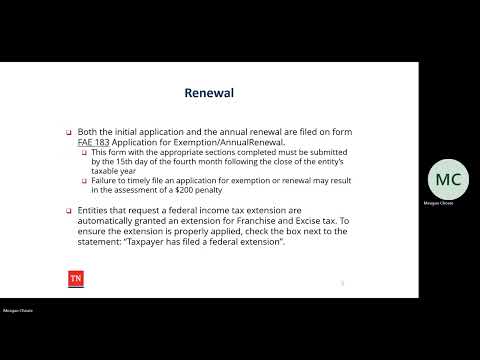
If an entity does not meet exemption requirements in any given year, it is taxable on all activities for that year and must complete a franchise and excise tax return. Choate said FAE 170 must be filed electronically with payment of any taxes due by the 15th day of the fourth month following the close of the taxable year. She repeated that both the initial application and the annual renewal must be submitted on form FAE 183 by the same deadline.
Choate warned that failure to timely file an application or renewal may result in the assessment of a $200 penalty. She also explained that entities that request a federal income tax extension are automatically granted an extension for franchise and excise tax and advised filers to "check the box next to the statement: 'Taxpayer has filed a federal extension'" to ensure the extension is properly applied.
For more information, Choate pointed listeners to the department's franchise and excise tax manual and the forms FAE 183 and FAE 170 on the Tennessee Department of Revenue website at tn.gov/revenue. She also provided a contact email (revenue.support@tn.gov), phone lines (general tax line 615-253-0600 and franchise and excise questions 615-253-0700), social media channels and weekday phone hours for assistance.
The presentation closed with a reminder that the statutory reference for the exemption is Tennessee Code Annotated section 67-4-2008 and that additional guidance and the application form are available on the department's website.