Get Full Government Meeting Transcripts, Videos, & Alerts Forever!
Get email alerts on the Transit Safety topic
No spam. Unsubscribe anytime.
Family of Pink Line Murder Victim and Other Riders Demand Action as CTA Outlines Security Efforts
Summary
Public commenters including the wife and a friend of Raymond Harrison, who was murdered on the Pink Line in December, demanded immediate, visible security beyond cameras. CTA leaders described a revised security plan, cited recent crime reductions, and pledged monthly security updates and follow‑up with the victim's family.
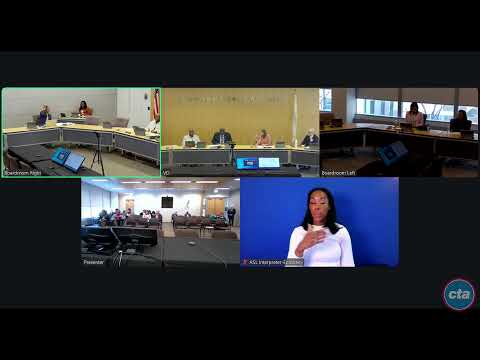
Several emotional public comments at the Chicago Transit Authority board meeting on April 8 pressed the agency for urgent security changes after a December murder on the Pink Line.
Tangela Scott testified that Raymond Harrison, "wasn't just a passenger or a headline" and urged the board to adopt "a visible, consistent presence" that prevents tragedies rather than relying on cameras. Markita Johnson, Harrison's wife, said she has not received contact from CTA and challenged the agency's claims of 24/7 security presence: "Where are the actual people that y'all are saying that's supposed to be on this train?" she asked.
Board members responded with condolences and commitments to follow up. Chairman Lester Barclay designated Eddie Winters from CTA security to connect with the family and asked for stronger accountability. Several directors requested a formal, measurable schedule of security updates; Chairman Barclay said he wants a monthly report on the security enhancement plan and, if necessary, personnel changes "from the top down." Director Rosa Ortiz proposed a multi‑agency collaborative in memory of Raymond Harrison to coordinate short‑ and long‑term responses with city and nonprofit partners.
Acting CTA leadership described recent steps and partnerships in response to system safety concerns. The agency said it submitted a revised security enhancement plan to the Federal Transit Administration, which relieved an immediate funding risk. CTA also said legal action helped resume federal funding for major capital projects. In published numbers cited to the board, CTA said CPD crime data show major crimes on CTA decreased 12% year‑to‑date and violent crime decreased 30% for March 2026 compared with March 2025. The agency also announced a Cook County State's Attorney's CTA Task Force to support prosecutions and a pretrial‑release protocol seeking detention for violent transit offenses.
CTA officials said they are expanding non‑law‑enforcement resources, piloting Safe Ride Ambassadors and increasing cleaning operations (nearly 3,000 rail deep cleans per month and 4,044 bus deep cleans per month). Still, family members and riders said those steps do not replace the need for visible security personnel and direct outreach to victims' families.
Board members pledged to keep safety "front and center," with several asking the agency to pilot "all‑hands‑on‑deck" interventions at high‑incident stations and to convene city partners for a coordinated response. The board approved a motion to receive monthly security updates and directed staff to ensure outreach and follow‑up with affected families.