Get Full Government Meeting Transcripts, Videos, & Alerts Forever!
Get email alerts on the Stormwater Dredging topic
No spam. Unsubscribe anytime.
Roswell approves 50% dredging reimbursement for Nesbet Lakes, defers Chering request for 90 days
Summary
After public testimony from residents of both neighborhoods, the Roswell City Council approved 50% reimbursement for Nesbet Lakes dredging with a midyear budget amendment to identify funding and deferred the Chering Lake request for 90 days to allow potential revenue to be recognized for 50% funding.
Mayor Mary Robisho and the Roswell City Council on Feb. 9 approved a 50% dredging reimbursement for the Nesbet Lakes application and deferred consideration of a larger Chering Lake request for up to 90 days to allow the city to identify additional funding.
The council voted to authorize the mayor or city administrator to accept Nesbet Lakes’ dredging assistance application and to process a required budget amendment to identify the funding source; the reimbursement was capped at $34,437.50. Brian Watson, director of Environmental and Public Works, told council that the city’s dredging assistance policy dates to 1998 (converted in 2016 to its current form) and allows cost-sharing up to 50% for projects that meet size criteria. He said Nesbet Lakes meets the threshold with a 320‑acre drainage area and about 256 acre‑feet of storage; the proposed work would remove roughly 4,500 cubic yards of sediment (about 900 round‑trip truck movements). Watson also emphasized that reimbursements cover only dredging operations and require a land disturbance permit and a staff inspection before payment.
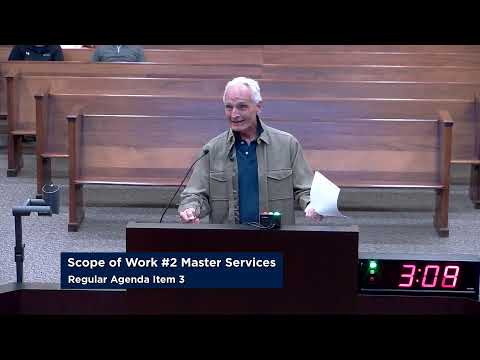
The measure followed extensive public comment. Jerry Lucas, a 29‑year Nesbet Lakes resident, said his community has spent roughly $45,000 to date on planning and permitting and that the ponds are part of the city’s stormwater infrastructure, not a neighborhood amenity. Lucas urged the full 50% reimbursement, saying the lower staff recommendation would “kill this program” and could leave downstream neighborhoods at risk. Chering residents made similar arguments: multiple speakers described multi‑year permitting delays, high pre‑construction costs, and shallow lake depths that they said reduce stormwater capacity and raise public‑health concerns.
Finance staff and the city’s CFO, Bill Gaw, noted budget constraints. Gaw told council that $250,000 was included in the 2026 budget as a set‑aside for dredging assistance, and finance recommended funding at 20% for some applications unless additional revenues or contingency are identified. Council members debated whether to use contingency funds, seek a midyear amendment, or defer one application to preserve fiscal flexibility. Councilmember Alan Cells moved to approve Nesbet Lakes at 50% with a midyear budget amendment to identify funding; the motion carried with one member opposed.
On Chering Lake, staff reported an estimated dredging cost of $650,000 and a requested 50% reimbursement ($325,000); staff recommended 20%. Chering residents described a four‑ to five‑year effort to secure permits and engineering work and asked the council to honor precedent for higher support. Councilmember Chris Zach moved to defer Chering for up to 90 days for 50% funding once potential future revenue could be officially recognized; that motion passed (3 in favor, 2 opposed). Staff indicated land disturbance permits may be extendable, and that applicants would need to update their applications if the project timeline changes.
What this means going forward: Nesbet Lakes’ application will proceed with the approved 50% reimbursement and a required midyear budget amendment to identify the funding source. Chering Lake’s application will return to council within 90 days if the city can identify additional revenue or otherwise secure a funding source to meet the 50% request. Neither project will receive contractor payment before the neighborhood pays invoices in full and meets permitting and inspection requirements.
Council members expressed an interest in revisiting the ordinance and the budgeting process for future, large‑scale dredging requests so the city can better anticipate and manage these recurring infrastructure needs.