Get Full Government Meeting Transcripts, Videos, & Alerts Forever!
Get email alerts on the School Finance topic
No spam. Unsubscribe anytime.
Norris School District 160 proposes $34.8 million bond for campus upgrades; tax impact estimated at about 9.5 cents
Summary
The Norris School District 160 presented a $34.8 million bond package on April 1, 2026, to repair roofs and HVAC, improve secure entries and ADA-accessible restrooms, relocate the bus barn and reconfigure drop-off lanes; district leaders estimate an illustrative levy increase near 9.5 cents but said that figure depends on a board decision to wrap existing debt.
Norris School District 160 officials on April 1 laid out a $34.8 million bond package they plan to place on the May 12, 2026 ballot, outlining building repairs, safety improvements and campus reconfigurations the district says are overdue.
"A $34.8 million bond issue would allow us to mobilize once, take care of all of the work," Superintendent Derek Joel said during a community presentation, describing the package as a way to complete decades of deferred maintenance and modernization in one financing cycle.
The bond package targets multiple needs across the campus: replacing or modernizing HVAC systems and controls at the high school and elementary school, roof replacements, relocating and redesigning main offices to create secure "mousetrap" entrances, renovating locker rooms and CTE spaces, adding ADA-compliant restrooms, moving the district bus barn to the campus perimeter to remove bus traffic from interior student areas, and creating dedicated pickup and drop-off loops and additional parking.
Joel said the $34.8 million figure emerged from a multi-step process that included a JDO facility audit, a community steering committee and several surveys that tested community tolerance for different bond-package sizes. He said committee feedback clustered in the $31 million–$35 million range and the board used that guidance to assemble the current package.
District officials provided several budget context points. The presentation noted prior financing actions: a roughly $3 million 2022 financing to replace middle-school HVAC and lighting, and a $2.5 million lease purchase in 2024 to fund tennis courts and the baseball field, augmented by private fundraising for extras such as scoreboards and a concession stand. Joel said those projects were funded through a mix of district funds and donations and emphasized the special building fund as a key financing source for non-operating capital work.
On tax impact, Joel provided an illustrative number: "we're looking at 9 and a half cents," but he stressed that estimate assumes a board decision to "wrap" existing intermediate-school debt into new debt. He said wrapping the intermediate bond is a board-level choice and the presented levy estimate used a flat property-valuation projection; future valuation increases would lower the levy impact per taxpayer if they occur.
When asked what would happen if the bond fails, Joel said the district would continue addressing needs through annual budgeting from its special building, depreciation and general funds but that doing work year-by-year risks higher future costs and slower progress: "the bond process would allow us to mobilize and take care of all of that work over a 20-year note versus doing that single year, single year."
Officials also described procurement and contingency plans: pre-bond contracts and guaranteed-maximum provisions were used to scope work; if final bids exceed the $34.8 million package the board could reduce scope or use the special building fund to cover overruns.
The district signaled some elements are immediate regulatory obligations: an ADA compliance safety audit identified required updates, and Joel said the district has addressed many items but lacks capacity for large-scale restroom upgrades without bond funding.
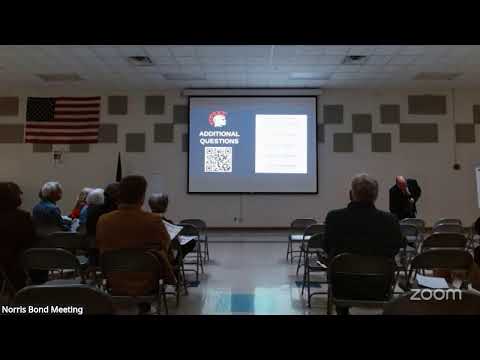
Next steps include a series of community presentations in nearby towns, livestreamed materials, and building tours offered to meeting attendees. The district asked residents to submit questions via a QR code provided at the meeting and said the board will consider debt-structuring choices such as whether to wrap existing bond debt after the May 12 vote.
The presentation referenced the Nebraska Transparency Act and the Open Meetings Act; no formal board vote on the bond was recorded at the meeting itself because the board previously called for the bond resolution to appear on the May 12 ballot.