Get email alerts on the Transportation Safety topic
No spam. Unsubscribe anytime.
Pasadena officials outline ‘safe system’ plan and push for speed, engineering and enforcement changes
Summary
City leaders presented a data-driven 'safe system' approach to reduce traffic deaths, set a goal of zero roadway fatalities by 2035, and described new engineering pilots, speed-management programs and enforcement partnerships; residents pressed for cameras, automated speed enforcement and quicker fixes at specific intersections.
City of Pasadena leaders on Thursday presented a multi-pronged plan to reduce traffic deaths, emphasizing engineering, education and enforcement while rolling out pilots that would test changes quickly before committing to permanent construction.
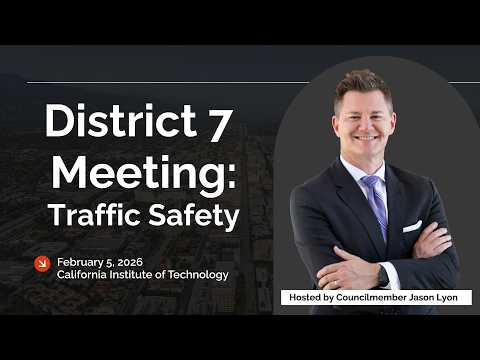
Councilmember Jason Lion opened the forum in District 7 and said the meeting was intended for residents to hear from city leadership and to offer feedback. "The point of tonight is for you to be able to hear from city leadership," Lion said, adding that recent fatal crashes made the discussion urgent.
The city's director of transportation outlined a 'safe system' approach that treats death and serious injury as unacceptable outcomes and assigns shared responsibility across designers, drivers and system managers. He said Pasadena adopted a focused local roadway safety action plan and set a goal of zero roadway fatalities by 2035, explaining the city averages about six fatalities a year and that achieving zero will require broad participation and multiple interventions.
Presenters showed a 10-year collision history and a five-year heat map (2021–2025) that concentrates injury collisions on major corridors such as Washington Boulevard and Orange Grove and in the central business district. The director noted that while 89% of collisions are vehicle-to-vehicle, pedestrians account for a disproportionate share of fatal collisions—roughly 46% of fatal crashes in the city's data.
To reduce speeds and severity, staff described programs that include arterial speed management, speed-feedback signs, neighborhood speed humps and a pilot for wider 'speed tables.' The presentation flagged Assembly Bill 43 as the state law that enables municipalities to designate safety corridors and, after appropriate studies, lower enforceable speed limits by up to five miles per hour on those corridors.
On engineering, the city highlighted recent projects (including a new traffic signal at Delmar and Michigan and reconfigurations on Union Street and Cordova) and listed near-term tools such as pedestrian hybrid beacons (HAWK signals), leading pedestrian intervals, centerline hardening at intersections and "quick-build" treatments using paint and plastic to test designs before building them in concrete.
Police Chief Eugene Harris and Lieutenant Anthony Russo detailed the department's role: education first, engineering support, then enforcement as a last resort. Harris described distracted-driver and pedestrian decoy programs; Russo said grant partnerships (including funding from the Office of Traffic Safety) pay for equipment and staffing. Russo reported about 1,037 traffic contacts in District 7 last year and roughly 6,786 citywide (warnings and citations combined).
Officials said technology will play a larger role: staff cited existing intersection cameras and third-party camera feeds the city uses for investigations, and described plans for an Active Intelligence Center to provide real-time data and analytics. They also said Pasadena is pursuing eligibility for state pilot programs that allow automated speed enforcement on corridors where speed has been shown to be a problem.
The meeting closed with staff urging community use of the Pasadena City Service Center app and hotline to report near misses and non-injury collisions so the city can track patterns and deploy data-collection devices or enforcement where needed.
City leaders said quick-build pilots and aggressive grant-seeking are intended to accelerate implementation, but they acknowledged that permanent projects and larger corridor changes will still require outreach, funding and staged construction.
AI generated
The text on this page is AI generated. Summaries, highlights, analysis, and video transcripts are all produced from the original source material.
AI can make mistakes, so if you spot one, and we will fix it for everyone.
Note: the source content is unaltered by us. Any content source we link to, be it a video, an audio recording, or a document, is presented exactly as its publisher released it. That publisher is usually a government body, sometimes an individual official or another organisation.