Get Full Government Meeting Transcripts, Videos, & Alerts Forever!
Get email alerts on the Transportation topic
No spam. Unsubscribe anytime.
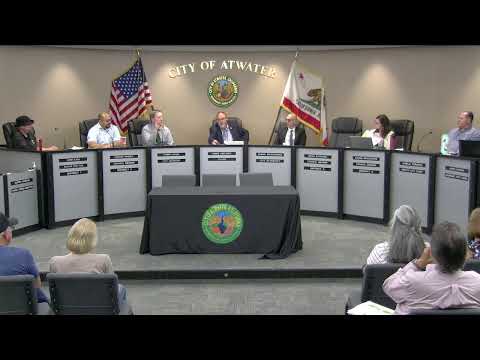
Atwater council OKs speed-hump plan for Fruitland Avenue, will reassess stop signs after construction
Summary
Following a public workshop, the Atwater City Council voted to install a modified version of Option B (four speed humps with an added fifth hump at the western curve) on the east segment of Fruitland Avenue and to reassess all-way stop warrants after roadway reconstruction is complete.
Atwater’s City Council voted to move forward with a community-backed traffic-calming plan for the east segment of Fruitland Avenue, adopting an amended version of “Option B” that installs speed humps and adds one extra hump on the western curve. Council members also directed that one-way stop controls on minor streets remain in place initially and that staff reassess whether all-way stop warrants are met after construction.
The decision followed a nearly three-hour public workshop in which city engineers outlined four traffic-calming alternatives for Fruitland Avenue’s phase-three reconstruction between Winton Way and Schaefer Road. Engineers said the project’s pavement, drainage and pedestrian improvements are fixed, and the remaining choice was which self-enforcing calming measures to build.
Contract city engineer Michael Hayes told the audience the city had removed traffic circles and chokers from the project and sought other calming approaches. Engineers described a range of measures, from raised intersections and medians (deemed impractical for this corridor) to vertical deflections. Rob Christensen, VDH Consulting civil engineer, summarized the options: a higher-frequency pattern (Option A) of roughly eight speed humps at recommended spacing (about 300–500 feet) and a lower-frequency pattern (Option B) with fewer humps and roughly 800-foot spacing. Option C paired the recommended humps with intersection bulbouts at Laura Lane and Capola; Option D reduced hump quantity but retained selected bulbouts.
City traffic engineer Jose Luis Benvidz explained why staff did not recommend reintroducing all-way stop signs across Fruitland. State guidance (the California Manual on Uniform Traffic Control Devices and related vehicle-code sections) requires specific traffic-count “warrants” or collision histories before engineers can recommend all-way stops; staff said existing counts on minor streets fall well short of the thresholds. Benvidz said Chardonnay’s highest hourly minor-street count, for example, was about 25 vehicles versus the roughly 200/hour needed in the warrant example discussed.
Several residents urged the council to keep the stop signs, recounting personal safety concerns and citing two earlier council resolutions they said previously authorized the signs. Roger Wood, a Fruitland resident, asked the council to move the sidewalk five feet to preserve a row of 100-year-old orange trees and said prior negotiations with the city over compensation were unresolved. Other residents described high speeds, near-miss crashes and two vehicles that had gone into an adjacent canal; one speaker said drivers “would go at least 60 miles an hour” on stretches of the road.
Opposing viewpoints were frequent. A local mechanic warned that repeated travel over multiple humps could accelerate suspension and steering wear on residents’ vehicles. Other residents raised concerns about emergency-vehicle access, noise and the ability of large vehicles or trailers to use narrowed intersections. Staff responded with engineering details: speed-hump prototypes are typically about 12 feet long with a modest vertical profile, and speed cushions can include gaps intended to let emergency vehicles straddle the raised areas.
To gather local preference, staff posted four concept boards and provided a survey; tabulation during the workshop showed Option B as the leading choice (36 responses) versus 10 for Option A, four for Option C and three for Option D. Councilmember discussion focused on whether to follow staff’s engineering judgment (which flagged legal risk if the city installs nonconforming all-way stops) or to heed resident safety concerns. The city attorney explained that design-immunity defenses under Government Code section 830.4 can protect public agencies only when plans conform to established standards; a court could find immunity unavailable if the city’s plan implicitly violated the California Manual on Uniform Traffic Control Devices.
A councilmember moved to implement Option B with speed humps and to revisit the stop-sign question later; the motion was amended on the floor to add a fifth speed hump on the western portion between the two curves (the location residents had requested). The amended motion—as clarified during the meeting—directed staff to construct the speed-hump plan (speed cushions/humps per the plan), retain one-way stop controls on the minor streets at the time of construction, and reassess after the pavement and calming measures are in place whether warrants for all-way stops are met. The council voted in favor (Kale: yes; Ambry: yes; Rochester: yes; Nelson: yes) and the motion passed.
Next steps described by staff include incorporating the selected calming details in final plans, coordinating driveway transitions with property owners, posting required advance signage, and returning to the council if engineering or legal conditions change. The council also asked staff to provide information about Government Code 830.4 and the California Manual on Uniform Traffic Control Devices as part of the record so elected members can weigh liability and safety tradeoffs when the project returns to them.
The council adjourned after the vote.