Get Full Government Meeting Transcripts, Videos, & Alerts Forever!
Get email alerts on the Immigration Support Funding topic
No spam. Unsubscribe anytime.
Seattle committee reviews $4 million plan to boost legal, language and community support for immigrants and refugees
Summary
The Libraries, Education and Neighborhoods Committee heard details about a $4 million expanded investment for immigrant and refugee services, including an RFP for removal-defense legal services (up to $1.25 million), rolling small community grants (up to $280,000) and funds for ESL, naturalization and ethnic-media outreach.
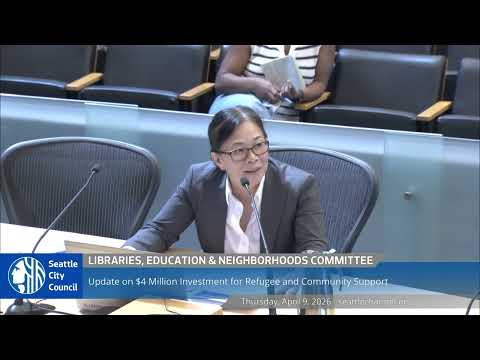
Chair Rivera convened a special meeting of the Libraries, Education and Neighborhoods Committee on April 9 to receive a briefing on how the City will spend a $4 million expansion to support immigrant and refugee communities.
Acting Director Cuc Vu of the Office of Immigrant and Refugee Affairs (OIRA) told the committee the funding package is meant to replace critical federal grants that have been reduced and to expand local rapid-response, legal defense, workforce and community-navigation services. "These additional resources will allow us to continue supporting the mounting challenges facing immigrant and refugee communities today," Director Vu said.
The package breaks down into discrete investment areas. OIRA announced an RFP for removal-defense community grants with up to $1.25 million available; the contract period will run June 1–Dec. 31, 2026, and the submission deadline is 5:00 p.m. April 24. Eligible applicants must be 501(c)(3) nonprofits with offices in Seattle or King County, include at least one DOJ-accredited representative or licensed attorney with two years' experience, and be able to begin proposed services within six months of contract execution, Director Vu said.
OIRA also described rolling small community grants totaling up to $280,000, with individual awards up to $10,000. The small grants are intended for neighborhood groups and very small organizations to provide basic needs support (meal delivery, food pantry items, diapers), "know your rights" information sessions, family-safety planning clinics with an immigration attorney, and technical-assistance to help new organizations contract with the city. Fiscal sponsorship by a 501(c)(3) is allowed to enable groups that lack nonprofit status to participate.
The office outlined additional allocations to help replace federal cuts: funding for naturalization services, support for ESL programs, a legal-orientation line item that supplements work at detention centers, a $300,000 emergency-assistance leveraging partnership with the Seattle Foundation, and modest ethnic-media funding (roughly $75,000–$125,000) and temporary staffing to scale OIRA operations.
Director Vu emphasized the scale of legal need in the region and the staffing implications for the office. She said the office is expanding its Legal Defense Network through the RFP to increase full representation capacity and that the program’s goals include doubling the active caseload the city funds (from about 250 to 500 cases) and supporting family members deriving benefits. Vu also described outreach and listening efforts — surveys, convenings and exchanges with peers in other cities — that informed the investment priorities.
Council members asked about access for non-501(c)(3) organizations and labor partners. Council Member Linn noted unions and worker organizations often help immigrant members but may not be 501(c)(3) entities; Director Vu said labor tax status is different and she would follow up, but reiterated the grants are designed to prioritize very small community organizations and that fiscal sponsorships and referrals are part of the plan.
OIRA will require grantees to submit aggregated reporting on activities, attendees and languages served; receipts or financial reports will be required for basic-needs spending, but the city will not collect identifying personal information, Vu said. The office will provide quarterly reports to council members and publish updates and RFP links on its website and in its newsletter.
Committee members thanked OIRA staff for moving quickly while attempting to remain data-driven and community-informed. Director Vu introduced several staff members in the audience and the chair closed the special meeting, noting the committee will return with further updates; the next meeting was announced for April 22.
The briefing did not include committee votes on legislation; instead, it focused on program design details, eligibility criteria and outreach plans for grant administration.