Get Full Government Meeting Transcripts, Videos, & Alerts Forever!
Get email alerts on the Housing topic
No spam. Unsubscribe anytime.
Placer supervisors keep housing element intact, ask staff to monitor low-income site capacity
Summary
After receiving the housing element and general-plan annual progress reports, supervisors opted not to reopen the county—s housing element now. Staff will monitor a slim surplus of lower-income site capacity and report back if pipeline projects change the county—s RENA position.
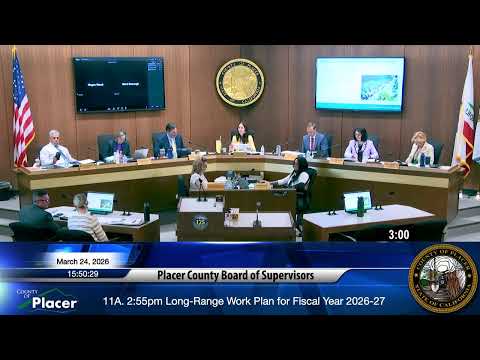
Placer County supervisors received the annual progress reports on the general plan and housing element on March 24 and agreed to continue monitoring site capacity for lower-income housing rather than open an immediate amendment to the housing element.
The board heard staff summaries and pipeline figures showing early production and projects under way. "We're making progress toward that goal," said Nikki Stregan, Placer County—s economic development and housing division manager, noting the county has tracked 148 housing units built or permitted since the housing action plan was adopted, primarily accessory dwelling units.
Why it matters: the state—s regional housing needs allocation (RENA) requires counties to plan — by zoning and site identification — for a set share of housing across affordability levels. Placer staff reported a modest surplus in the county—s capacity for lower-income units (staff—s accounting showed an 85-unit surplus at the time of the presentation). If that surplus dropped into a shortfall, state law would require a rapid response and the county would have 180 days to add sites or otherwise restore capacity.
Staff—s recommendation and rationale: Planning staff recommended continuing to monitor activity rather than open a formal housing-element amendment now. "We believe there is enough affordable housing in the pipeline," said Emily Seltzer, principal planner, adding that projects active in the entitlement pipeline and a handful of county-led or partner projects could add capacity without reopening the housing element. The board directed staff to keep the board informed and said it wanted stronger outreach to property owners and real-estate professionals about potential candidate parcels.
What staff is watching: staff highlighted several developments that could materially change the county—s position, including projects in the Placer Vineyard specific plan area and a Project Homekey application being developed by Health & Human Services that could add roughly 55 very-low-income units if approved and built. Planning staff said those built units would count toward the county—s production totals even if the parcels are not currently listed in the housing-element sites inventory.
ADUs and affordability: Accessory dwelling units continue to be a significant near-term source of small, market-accessible housing. Under the county—s policy ADUs under 750 sq ft are treated as affordable-by-design for housing-element accounting. Staff reported ADU production in 2025 but noted that full monitoring of availability and affordability requires periodic homeowner surveys and continued outreach.
Board direction and next steps: Supervisors asked staff to (1) continue monitoring building permits and the sites inventory, (2) expand public outreach (including a simple property-owner submission form and targeted outreach to listing agents), and (3) coordinate closely with the county—s Housing Action Plan team and local cities on regional options. If a large pipeline project emerges that would materially affect the lower-income capacity, staff will return to the board with options, including the possibility of opening a housing-element amendment.
By the numbers: staff reported an 85-unit surplus for lower-income capacity in the current inventory, substantial capacity for moderate- and above-moderate units, and 148 units recorded since the Housing Action Plan adoption (largely ADUs). County staff cautioned those figures are monitored regularly and may change as permits issue or new projects are proposed.
What—s next: staff will keep the board updated on permits and pipeline projects; the general-plan update (Placer 2050) and the next housing element cycle remain multi-year efforts that will shape longer-term capacity and policy.