Get Full Government Meeting Transcripts, Videos, & Alerts Forever!
Get email alerts on the Special Education topic
No spam. Unsubscribe anytime.
Monomoy director says in‑district special‑education programs yield about $3 million in savings
Summary
Monomoy’s director of student services gave a detailed overview of special‑education programming across preschool through age 22, citing volatile enrollment (301 in October; 281 in January), a wide range of out‑of‑district tuition rates, and an estimated $3 million cost‑savings from keeping intensive programs in district.
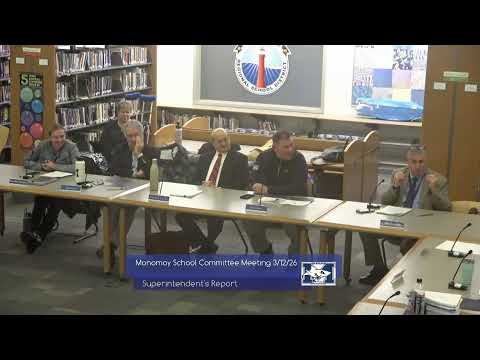
Director of student services Maguire outlined the district’s special‑education programs and their budget implications during the Monomoy Regional School Committee meeting on March 12.
Maguire said the district served 301 students receiving special‑education services in its October report and noted the January snapshot showed 281, underscoring that eligibility and counts change throughout the year. She described a layered program structure from integrated preschool and inclusion supports through intensive high‑school programs and a 18–22 shore program that includes work‑based learning.
On costs, Maguire compared in‑district supports with out‑of‑district tuition. She used a conservative baseline tuition of about $63,000 for a day placement for comparison and noted that residential and specialized placements can run much higher, in some cases into the mid‑hundreds of thousands. "Those differences add up," she said, explaining her office’s analysis showing an estimated total cost savings of about $3 million by operating expanded in‑district intensive programs rather than sending an equivalent cohort out of district.
Maguire described the related services that support those students—speech and language, occupational and physical therapy, school nursing, orientation and mobility, teacher of the visually impaired and teacher of the deaf—and the district’s clinical team, which includes behavior analysts and school psychologists. She summarized summer extended‑school‑year offerings (an intensive six‑week track and a four‑week academic track) and the district’s use of contracted services where needed.
Funding sources discussed included Chapter 70 state aid, circuit‑breaker reimbursement for special‑education costs, federal 240/262 entitlement grants and Medicaid reimbursements for eligible services. Maguire emphasized the block‑grant and entitlement funds are used for equipment and specialized services that the regular budget cannot reliably cover.
Maguire also described operational adjustments for FY27—reallocating speech‑language personnel to meet building‑level need and shifting fractional staffing to increase counseling capacity at one elementary school—saying the moves were budget‑neutral and aimed at efficiently matching staff to student needs.
The presentation did not include an immediate request for additional dollars; administrators said the budget implications are folded into the FY27 draft under consideration. Maguire invited committee questions and noted the district will continue tracking evaluations in process and three‑year re‑evaluations through the spring.