Get Full Government Meeting Transcripts, Videos, & Alerts Forever!
Get email alerts on the Evacuation And Resilience topic
No spam. Unsubscribe anytime.
Fire officials in South Lake Tahoe urge residents to prepare as evacuation planning and fuels work intensify
Summary
At a Lake Tahoe Southshore Chamber forum, local chiefs and federal and state partners emphasized fuels reduction along evacuation routes, the renewed basin Community Wildfire Protection Plan and new detection technology, and urged residents to use Ready-Set-Go guidance and local apps during emergencies.
A panel of local, state and federal fire and water officials told a South Lake Tahoe audience that constrained road access and changing fire behavior make evacuation planning and fuels reduction along evacuation routes the top priorities for community safety.
"Our number one priority with the Tahoe fire and fuels team is the fuels reduction along our evacuation routes," said Jim Drenan, fire chief for the City of South Lake Tahoe, noting the basin’s limited ingress and egress in a catastrophic event and urging residents to follow directions from law enforcement and incident command during emergencies.
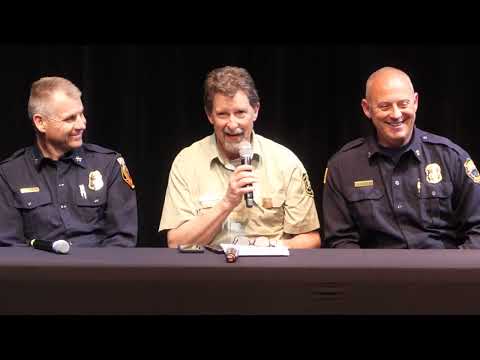
The forum — hosted by the Lake Tahoe Southshore Chamber of Commerce and moderated by Chief Drenan — brought together chiefs from Lake Valley Fire, Tahoe Douglas, CalFire and representatives of the U.S. Forest Service, who described coordinated, near‑daily planning through the Southshore Division and the Tahoe Fire and Fuels Team. Eric Walker, forest supervisor for the Lake Tahoe Basin Management Unit, said the unit remains staffed for fire response and that funding for fuels and preventative work was forthcoming.
Organizers highlighted several preparedness and detection tools: the regional Ready‑Set‑Go guidance for individual evacuation choices; the WatchDuty app for push notifications; Perimeter Solutions and other evacuation-software integrations used by multiple counties; and AlertWildfire cameras with AI that can validate smoke reports and, in remote areas, detect fire activity faster than some 911 calls. "A picture is worth a thousand words," explained a CalFire representative describing camera use for both detection and prescribed-fire oversight.
Panelists also discussed how development type affects response. New, large complexes built to current codes — with sprinklers, Class A roofing and fire-resistive features — may be safer and, in some cases, better suited to sheltering in place. By contrast, older, denser neighborhoods built before modern standards remain a priority for fuels treatments and evacuation-route clearance.
The basin’s recently renewed Community Wildfire Protection Plan (CWPP), led by Tahoe Resource Conservation District with funding from the California Tahoe Conservancy, was described as essential for coordinating projects and unlocking grant funding. "If you don't have a CWPP that calls out the things you need to do, you're not going to be able to get the work done," said Martin Goldberg, Battalion Chief with Lake Valley Fire.
Water-supply capacity for large wildland incidents was a recurring concern. South Tahoe Public Utility District's Shelley Thompson said the basin has invested in more than $50 million of water-infrastructure upgrades since the Angora Fire, including upsizing mains and adding hydrants, tanks and interties, but cautioned municipal systems are designed primarily for domestic and structure‑fire loads and not continuous, region‑wide wildland firefighting demands.
Officials urged neighborhood-level action: forming Firewise communities, pursuing defensible‑space work and using qualified assessors to evaluate home hardening. Jeff Hog, battalion chief overseeing wildfire strategy for the Amador‑El Dorado unit, described local training that has produced more than 70 qualified assessors who can give detailed defensible‑space guidance.
The forum closed with organizers directing attendees to local booths and upcoming events (a wildfire expo and Firefest) and encouraging residents to sign up for evacuation alerts, review the CWPP online, and take concrete home‑hardening steps.
The forum did not include formal votes or policy decisions; panelists encouraged continued engagement with local fire districts, the Forest Service and state legislators to secure funding and implement projects.