Get Full Government Meeting Transcripts, Videos, & Alerts Forever!
Get email alerts on the Criminal Justice Miller Resentencing topic
No spam. Unsubscribe anytime.
Justices Hear Whether Prosecutors May Compel Psychological Exams at Miller Resentencings
Summary
In People v. Donielle Black, attorneys and an amicus argued whether compelling a defendant to submit to a prosecution psychological examination at a Miller resentencing hearing would violate the Fifth Amendment or could be limited to rebuttal; the court submitted the case after extensive questioning on scope, disclosure, and statutory authority.
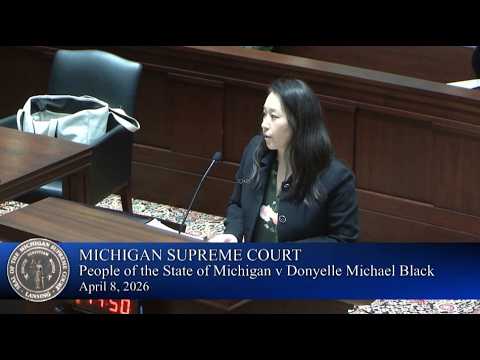
Justices of the Michigan Supreme Court heard oral argument in People v. Donielle Michael Black over whether prosecutors may compel a defendant to undergo a psychological examination at a Miller resentencing hearing and whether such an exam (or a trial court's reliance on an earlier hearing record) can waive the defendant's Fifth Amendment privilege.
Defense attorney Charity Lee of Cleary Gottlieb told the court that “the Fifth Amendment applies to Miller hearings and Fifth Amendment waivers are proceeding specific,” and argued no new waiver exists for a second Miller hearing in Mr. Black’s case. She said the prosecution has not disclosed its case-in-chief, leaving the defendant unable to decide what mitigation to present, and contended that admitting prosecution-driven testimony derived from a compelled examination would be a Fifth Amendment violation.
An amicus for the State Appellate Defender Office, Jacqueline Uvry, urged the court to adopt rules protecting a defendant’s privilege at sentencing. Uvry noted past statutory authority for compelled sentencing evaluations has been narrowed by amendment and cautioned the Court of Appeals’ rule—allowing compelled exams whenever a defense expert addresses a Miller factor—“goes too far” and is inconsistent with precedent such as Wright and the line of Cheever/Buchanan decisions.
Representing the people, Jack McIntyre framed the question around truth-seeking and rebuttal. He told the court allowing a defendant to use an examining expert “as a sword” while denying the prosecution meaningful rebuttal would undermine the adversarial process. McIntyre argued that in some cases a compelled examination limited to rebuttal (and to the scope of the defense expert’s evidence) may be necessary to test inconsistent statements and assure accurate information is before the sentencing court.
During argument the bench repeatedly probed practical and doctrinal limits: whether Miller hearings—designed to evaluate the defendant’s capacity for rehabilitation—differ from other sentencing proceedings; how to draw a one-to-one scope for a rebuttal examination; whether institutional records and prior MDOC evaluations suffice in many adult resentencings; and how to ensure advance disclosure so each side can prepare. Defense counsel replied that alternative avenues—record review, cross-examination of defense experts, and limitations grounded in existing law—often eliminate the need to compel a defendant’s own examination.
Counsel also debated whether a trial court’s sua sponte judicial notice of a prior Miller hearing record could operate as a waiver of the privilege; defense counsel said it could not, while the people stressed the court must be able to test and rebut mitigation evidence admitted by a defendant.
The argument drew several case-law references: Wright and Taylor (on waiver and burdens), Cheever and Buchanan (on compelled examinations and the Fifth Amendment), and appellate decisions like State v. Madison. Statutory citations discussed included MCL 771.14 and MCL 769.25/769.25a in the context of whether legislative text authorizes compelled evaluations for sentencing purposes.
The court submitted the case without announcing a decision. The justices’ questioning signaled attention to both constitutional limits on compelled testimony and the practical needs of sentencing courts to receive accurate, testable information when considering mitigation at resentencing.