Get Full Government Meeting Transcripts, Videos, & Alerts Forever!
Get email alerts on the Fleet Management topic
No spam. Unsubscribe anytime.
Sequim fleet manager tells council city’s 153 vehicles are kept longer due to low mileage, outlines data-driven replacement plan
Summary
Matt Shackelford, Sequim’s fleet, facilities and asset manager, briefed the city council on the 153-unit fleet, recent investments, use of Cartegraph asset-management software, condition-scoring tools (OCI/VRR) and replacement scheduling to avoid unexpected costs.
Matt Shackelford, fleet, facilities and asset manager for the City of Sequim, told the City Council the city’s fleet is smaller and used less than those of larger municipalities, which lets Sequim keep vehicles longer while still maintaining reliability.
Shackelford said the fleet division oversees maintenance and repairs for 153 rolling-stock units — from riding lawnmowers and police patrol cars to heavy dump trucks and tracked excavators — plus 15 site emergency generators and a range of small-engine tools and attachments. "The fleet division oversees the maintenance and repairs to a total of 153 units," he said.
Why it matters: Shackelford said limited geographic size and lower annual mileage reduce wear, which affects replacement timing and budget planning. He reported the fleet’s current average model year is 2015 and the average annual mileage across vehicles is about 5,500 miles, though some vehicles average roughly 11,000 miles and others under 500.
Inventory and valuation: Shackelford stated the city has invested just over $8 million in the purchase of the current fleet, a figure he said "equates to $12.5 million dollar value in today's dollars." The presentation did not specify the inflation index or base year used for that adjustment.
Shared use and staffing: The fleet includes six shared administrative vehicles and additional shared units across divisions. Shackelford described an IT-supported checkout process for shared vehicles and said the police department historically managed its own fleet while public works and police department staff are working toward a city-incorporated fleet. He noted the fleet team currently consists of the fleet manager and a chief mechanic and stressed time management is important given that staffing level.
Maintenance and outsourcing: More than half the fleet receives preventative maintenance less than once per year, making each shop visit an important inspection point, Shackelford said. The city outsources specialty services that require specialized tools or licenses when financially prudent; the presentation noted oil changes were considered for outsourcing but staff concluded vendor oversight reduces staff familiarity with vehicles and provides limited financial benefit.
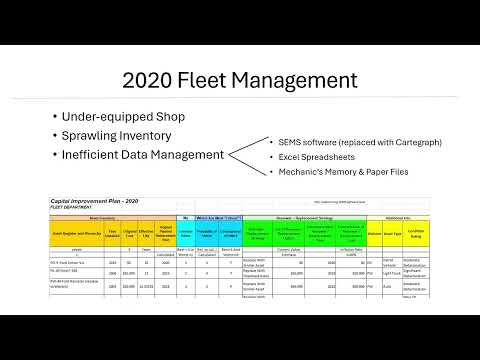
Data tools and condition scoring: In 2021 the city moved its inventory into Cartegraph Asset Management (now owned by OpenGov) and uses Cartegraph’s fleet module for inventory, maintenance tracking, conditional assessments and replacement ratings. Shackelford described two condition tools used in the system: the overall condition index (OCI), a score out of 100 (higher is better), and the vehicle replacement rating (VRR), a score originally described as out of 30 (lower indicates less likelihood of replacement). He gave an example OCI of 81.99 and a VRR of 6.91 for a sample truck and reported an overall city VRR of 10.16 out of 25, noting the city views VRR on a 25-point scale to compensate for limited historical data prior to 2021.
Replacement policy and examples: Shackelford said the city uses lifecycle and repair-cost analyses to time replacements so vehicles are surplused before repair costs exceed remaining value. He cited heavy trucks as an example of differing life cycles: until a recent purchase of three used dump trucks last year, some heavy trucks used by the city had been in service for decades — he reported prior trucks were 40 years old with about 34,000 miles — demonstrating longer-than-typical service life in Sequim's operating context.
What’s next: Shackelford closed by offering to answer council questions or provide additional information. The presentation provided a mix of quantified fleet metrics, an overview of tools used to guide replacement timing, and operational context that the council can use for budgeting and policy discussions.