Get Full Government Meeting Transcripts, Videos, & Alerts Forever!
Get email alerts on the BLM Cooperation topic
No spam. Unsubscribe anytime.
Lane County signs on as BLM cooperating agency and names AOCC its representative despite concern about staff capacity
Summary
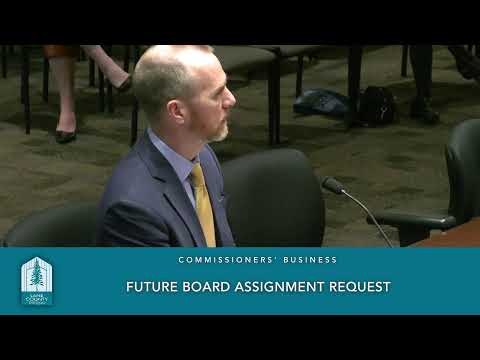
The board approved delegating authority to the county administrator to sign a cooperating-agency MOU with the Bureau of Land Management for ONC lands and designated the Association of Oregon and California Counties (AOCC) as Lane County’s representative; the decisions followed debate about whether county staff or AOCC would best advocate Lane County’s interests.
Lane County’s Board of Commissioners voted to accept an invitation from the U.S. Bureau of Land Management to serve as a cooperating agency on a planned revision to the Western Oregon Resource Management Plan for Oregon and California Railroad (ONC) lands, and separately designated the Association of Oregon and California Counties (AOCC) as Lane County’s representative in the process.
County staff described the ONC lands as roughly 385,000 acres within Lane County and said cooperating-agency status would allow the county to provide subject-matter expertise and data to BLM’s environmental impact statement process. Steve Adams, representing the county policy team, told commissioners the role could encompass topics from search-and-rescue and transportation to social and economic conditions.
The board first approved an order delegating authority to the county administrator to execute the memorandum of understanding with the BLM. That motion, amended to remove one subsection, passed on a voice vote.
Commissioners then debated whether AOCC or county staff should serve as the county’s primary representative. Supporters of AOCC said the association has federal lobbying capacity, subject-matter staff, and experience convening multiple counties. Commissioner Leval argued the association’s resources and existing advocacy relationships would amplify Lane County’s voice: "Because we joined the AOCC 3 years ago, our participation and our membership has strengthened the ONC counties in their efforts to lobby for the good of this county in such a huge way," he said.
Vice Chair Buck and Commissioner Trigger opposed naming AOCC as the primary representative, arguing for stronger direct staff involvement and more transparency from AOCC; Buck requested that AOCC provide complete minutes and noted staff should be closely involved so Lane County issues remain prioritized.
After debate the board approved a separate order designating AOCC as the representative; the designation passed 3-2 with Vice Chair Buck and Commissioner Trigger opposed. Staff confirmed the board can change its representative later by letter and said county staff would still participate and feed local data into AOCC’s work.
Next steps: the county administrator has authority to execute the cooperating-agency MOU with the Bureau of Land Management; the board’s designation names AOCC as the initial representative but preserves the ability to alter representation in writing. Staff will coordinate data gathering and stakeholder engagement to inform the federal planning process.
The decision gives Lane County a formal seat in a federal planning process that could influence forest- and resource-management decisions affecting large areas of county jurisdiction.