Get Full Government Meeting Transcripts, Videos, & Alerts Forever!
Get email alerts on the Expert Testimony topic
No spam. Unsubscribe anytime.
Defense says 'medical torture' expert testimony invaded the jury's role in People v. Alexander
Summary
At oral argument, defense counsel told the court that an expert's use of the term "medical torture" and her reliance on witness accounts effectively substituted expert judgment for the jury's factfinding; the prosecution argued the diagnosis was defined, limited, and properly presented for the jury to weigh.
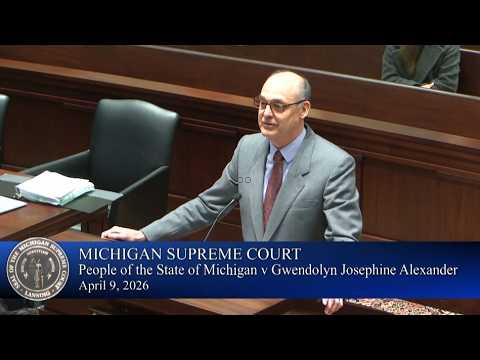
Mike Middlestadt, an attorney with the State Appellate Defender's Office, told the court that expert testimony labeling a child's condition "medical torture" crossed the line into legal decision-making and prejudiced his client, Gwendolyn Alexander.
"All that leads up to the inescapable conclusion that this testimony invaded the province of the jury," Middlestadt said, arguing the expert's language "connoted culpability, criminality, assault" and effectively mirrored the mens rea elements the jury was charged to decide.
The defense contended the expert's opinion relied heavily on witness reports, including statements from an aunt who did not testify at trial, and that portions of the testimony went beyond what the jury had heard. Middlestadt urged the court to reverse Alexander's conviction and remand for a new trial, and he raised an alternative ineffective-assistance claim under Strickland, saying counsel's failure to press the correct objection compounded the error.
"It was the jury's job," Middlestadt said, describing the expert's diagnosis as offering no information beyond what the jury could and should evaluate itself.
Dan Heble, appearing for the people and representing Wayne County, urged the court to deny the application and cautioned against creating a remedy the state said was not needed. "We are asking that this court does not create a remedy for a problem that doesn't exist," Heble said. He argued the doctor provided a defined diagnostic framework, explained the clinical basis for her conclusion, and that the trial record and instructions left the jury free to accept or reject the expert's opinion.
Members of the bench pressed both sides on where the line falls between permissible expert diagnosis and impermissible testimony that effectively vouches for credibility or supplies legal conclusions. One justice framed the question as whether the expert had "vouched" for witnesses or had "invaded the province of the jury," and counsel responded that the two can overlap when an expert endorses non-testifying reports and then uses terminology that mirrors the charged offense.
The lawyers debated precedent and standards cited during argument. Middlestadt relied on decisions warning against experts adopting labels that duplicate criminal charges; he also raised the standard for plain-error review and argued that the combined effect of the testimony met the relevant prejudice tests. Heble countered that the term "medical torture" has appeared in a small number of peer-reviewed discussions and that the context, cross-examination, and jury instructions limited any potential confusion.
Both sides discussed whether the expert's reliance on medical records, interviews and reports ran afoul of cases forbidding experts to base conclusions solely on witness statements. Heble said the doctor performed a differential diagnosis and reviewed the medical history and reports, while the bench questioned whether that method still risked importing untested factual assertions into the expert's testimony.
The argument also touched on whether "torture" carries a more loaded meaning than terms such as "abuse" and whether that colloquial weight could mislead jurors. Counsel and the bench discussed cross-examination and limiting instructions as remedies, but disagreed on whether those safeguards sufficed in this record.
At the close of the mini-argument, Middlestadt reiterated his request to reverse and remand; Heble urged denial. "The case will be submitted," the court announced. No decision was made from the bench during the argument; the court will issue a written disposition at a later date.
The case centers on how courts should treat forensic or clinical diagnoses that reuse language similar to criminal offenses and on whether defense counsel's objections were sufficient to preserve or compel review of any error.