Get Full Government Meeting Transcripts, Videos, & Alerts Forever!
Get email alerts on the Energy Policy Ad Hoc topic
No spam. Unsubscribe anytime.
Lake County names deputy as single energy contact and tasks ad hoc with geothermal setback review
Summary
County staff recommended and the board agreed to designate Deputy County Administrative Officer Benjamin Rickleman as the single point of contact for energy proposals and asked the energy policy ad hoc committee to review geothermal setback rules amid public concerns about AB531, water and local control.
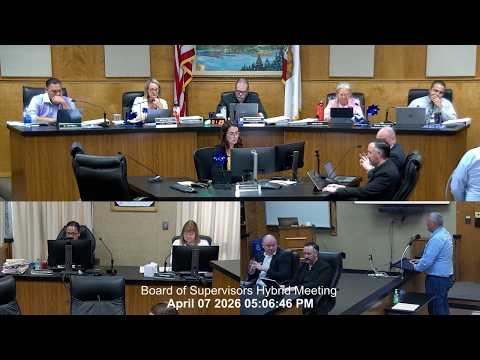
At a board meeting, Lake County supervisors agreed to name Deputy County Administrative Officer Benjamin Rickleman as the county’s initial single point of contact for incoming energy project and policy proposals and directed the county’s energy policy ad hoc committee to review the county’s geothermal setback ordinance.
Chief Deputy County Administrative Officer Matthew Rothstein told the board the ad hoc committee—made up of Supervisors Pisca and Owen, department heads Maria Turner and Lars Ewing, Treasurer Patrick Sullivan, Benjamin Rickleman and Rothstein—has begun early work and that centralizing inquiries would ensure a uniform review process. “Positioning committee member and economic development focused deputy county administrative officer Ben Rickleman as the initial point of contact for energy project and policy proposals is sensible and supported by the committee,” Rothstein said.
Rickleman said staff have held preliminary conversations about possible organizational partnerships to improve reliability and reduce costs and are evaluating several models. “There’s been preliminary conversations regarding potential organizations the county could join to for both reliability and to try to address cost concerns regarding energy,” he said, and added staff expect to return to the board with recommendations.
Public comment at the meeting emphasized local control, water and revenue issues. A commenter identified as Mr. Lys urged the county to adopt ordinances so that “if you’re going to drill in Lake County, you’re going to have to pay the county a franchise fee,” and suggested the county seek wholesale purchase rights so power could be redistributed through a community choice aggregator.
Charles Morris warned that geothermal development can demand large quantities of water, saying, “for all these geothermals, you’re going to have to have water because it’s basically fracking.” Marggo Kambara urged the committee to pursue “energy sovereignty” by examining a broad resource portfolio—geothermal, wind, solar, battery storage and market power—and recommended public updates on the options considered and why alternatives might be rejected.
Sterling Wman urged the board to finalize an energy policy before the county’s general plan is adopted in August–September so that the plan can influence how the state applies AB531; Wman said failing to do so could cede siting and water-use decisions to outside developers. Betsy Khan urged protection of the Clear Lake Basin watershed and suggested reusing treated effluent from the Kelseyville wastewater treatment plant as a potential reinjection source for geothermal operations.
On specific next steps, supervisors recommended preparing standard developer-agreement templates and transparent guidelines tied to thresholds of capital investment and producing a GIS shape file for existing geothermal setbacks. The board reached consensus to assign the ad hoc committee to review the county’s geothermal setback ordinance and to designate Rickleman as the initial point of contact for energy-related inquiries. Staff said it will return with recommendations to the board.