Get Full Government Meeting Transcripts, Videos, & Alerts Forever!
Get email alerts on the Budget topic
No spam. Unsubscribe anytime.
Mahwah Township Public School District reviews 2026–27 preliminary budget as health and special-education costs rise
Summary
At its April 8 meeting the Mahwah Township Public School District board heard a detailed expenditures presentation for the 2026–27 preliminary budget, which flagged special education and rising health-benefit costs as the primary drivers and set an April 29 adoption date.
The Mahwah Township Public School District Board of Education on April 8 received the second of three presentations on the 2026–27 preliminary budget, which shifted the focus from revenue to expenditures and identified special education and health benefits as the largest cost drivers.
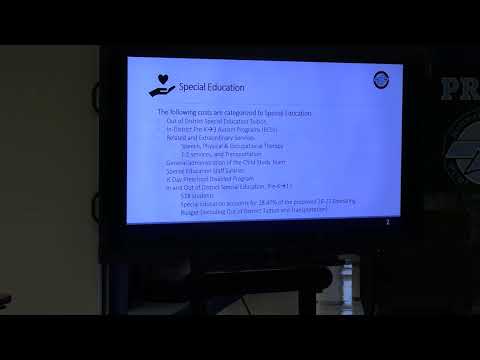
The presentation, delivered by the district’s budget presenter, said 518 students receive special-education services in- and out-of-district and that special education represents 28.47% of the proposed operating budget. The presenter noted 113 students were budgeted for tuition-based placements outside the district for 2026–27 — 65 of them special-education placements — and said those placements include private school contracts, Bergen County special-services programs, vocational technical schools and county college enrollments.
Why it matters: Special-education placement costs and the structure of mandated services are a major portion of district spending that the board must cover while balancing other priorities such as staffing and transportation.
The board heard that employee benefits are another major budget line. The presenter said total employee benefits are budgeted at a level representing roughly 16.9% of the operating budget and that the district expects a year-over-year increase driven primarily by health-care cost growth. The presentation broke the health-benefit forecast into components, projecting roughly a 20% increase in medical costs, a 40% increase in prescription benefits and a 12% increase in dental costs; employee contributions were reported in the presentation as roughly 14.3% of total healthcare costs.
Enrollment and staffing details: The district reported an October enrollment snapshot of 2,559 in-district students (1,150 in preK–5, 601 in grades 6–8 and 88 in grades 9–12), a decline of 51 students from the prior year. Staffing was described as the single largest expenditure category; the presenter said the district currently supports about 470 full‑time-equivalent positions and anticipates a net reduction of six FTEs for 2026–27 after careful review.
Transportation and other operations: The board was told a transportation committee was formally established in January 2026 to improve oversight. The presenter said the district provides transportation to more than 2,000 eligible in‑district students in accordance with state statute and reported a transportation budget of $7,148,479 (8.34% of the operating budget) for 2026–27; existing contracts were renewed in line with the consumer price index (3.58%). Other categories discussed included instructional support, district operations and technology, maintenance and extracurriculars, with some school‑level budgets reduced after a historical trends review.
Numbers in transcript: Several monetary figures in the meeting transcript appear garbled (for example, the special‑education amount appears as '24,44,727' and some other totals include misplaced commas). Where figures were unclear in the record the presenter’s percentages, counts (students and FTEs) and the transportation budget were used for context; the board will receive a full, final budget document before adoption.
Next steps: The presenter closed by noting the final budget presentation and anticipated adoption is scheduled for April 29. The board did not take a final adoption vote on April 8; more detailed finance-and-facilities review is planned at the next committee meeting.