Get Full Government Meeting Transcripts, Videos, & Alerts Forever!
Get email alerts on the Education Postsecondary Outcomes topic
No spam. Unsubscribe anytime.
Dr. Walker reports 94% of Chatham High’s Class of 2025 will attend four‑year colleges
Summary
At a School District of the Chathams Board of Education meeting, Dr. Walker presented the Class of 2025 graduates report: 94% of last year’s class continued to four‑year universities, the district processed 3,029 college applications with a mean acceptance rate just over 53%, and counseling programming logged about 120 college rep visits.
Dr. Walker presented the School District of the Chathams’ annual graduates report to the Board of Education, saying the Class of 2025 continued to show high postsecondary placement rates. “Last year’s class, 94 percent of the students continuing on to 4 year universities,” Dr. Walker said, and the full report will be posted on the high school website as a reference for students and families.
The presentation included five‑year placement trends and GPA distributions. Dr. Walker said about half the class had GPAs above 4.0, with the largest share in the 3.0–3.99 band. He noted that students with GPAs below 3.5—roughly the bottom 25%—still had about an 80% four‑year placement rate.
Dr. Walker detailed outcomes for students with individualized education programs (IEPs): almost 72% continued to four‑year universities, 9% to two‑year programs and 13% to other post‑secondary options, while some pursue the district’s 18–21 program, trade schools or employment.
On application volume, Dr. Walker said the district processed 3,029 applications resulting in 1,612 acceptances—a mean acceptance rate just over 53%—and reported an average of 9.8 applications submitted per student and an average of 5.2 acceptances per student. He said about 51% of applications were early action (commonly with a November 1 deadline) and about 5% were early decision, placing increased demand on counseling staff during the fall.
Dr. Walker described geographic and institutional patterns: roughly 44% of the class remained in East Coast regions, about 11% stayed in New Jersey, and collectively about 55% matriculated in the Northeast corridor. He listed commonly attended institutions, noting Rutgers received 113 applications from the class; other frequently applied institutions included Penn State, Northeastern, Syracuse, the University of Pittsburgh and Virginia Tech.
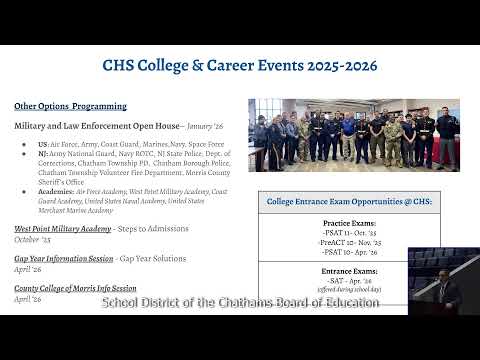
Counseling and college‑readiness programming, Dr. Walker said, included about 120 college representative visits to the college and career center, junior planning nights, vocational programming, college admissions panels, a college funding night, alumni return day, a military and law enforcement open house, information sessions on West Point and gap‑year options, and administration of PSAT/SAT/ACT offerings. He thanked college career counselor Miss Lewis for coordinating data and programming.
The report, Dr. Walker said, is intended both to inform board oversight and to serve as a resource for students’ college searches. The board will retain the report on the high school website for reference.