Get Full Government Meeting Transcripts, Videos, & Alerts Forever!
Get email alerts on the Infrastructure topic
No spam. Unsubscribe anytime.
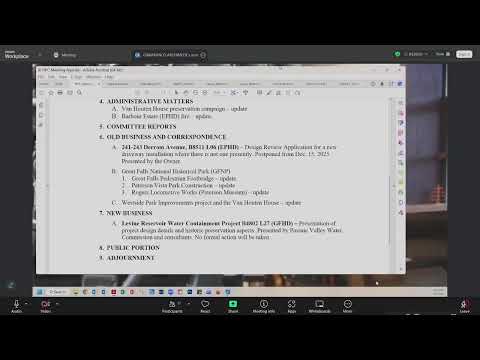
Passaic Valley Water Commission presents Levine Reservoir replacement and $2 million mitigation plan to Paterson HPC
Summary
Passaic Valley Water Commission consultants presented plans to replace the open Levine Reservoir with covered storage tanks, explaining EPA compliance needs and mitigation measures including a $2 million mitigation fund, interpretive signage and rehabilitation of historic fence posts and retaining walls.
Consultants for the Passaic Valley Water Commission (PBWC) updated the Paterson Historic Preservation Commission on March 9 about the Levine Reservoir water‑storage project in the Great Falls National Historic District, explaining why the open finished‑water reservoir is being removed and replaced with covered tanks and describing mitigation measures approved with historic‑preservation stakeholders.
Eddie Gajek of Mott MacDonald said the Levin(e) Reservoir project responds to U.S. Environmental Protection Agency rules requiring finished water in open reservoirs to be protected or treated to address pathogen risks. PBWC plans to remove the open reservoir and install two 2.5‑million‑gallon storage tanks located farther from Grand Street, a small chemical feed building, access road and two stormwater detention basins. The project is already in construction; PBWC awarded a contractor and work is underway.
Gajek described negotiated mitigating steps intended to reduce visual and historic impacts: a $2,000,000 mitigation fund for capital improvements triggered on permit issuance, recording the reservoir in the Historic American Engineering Record, rehabilitating concrete obelisk fence posts and repointing the Grand Street retaining wall, siting tanks to the north to reduce visibility from Grand Street, and landscaping to screen the tanks. He also said PBWC coordinated with multiple agencies over time — including the New Jersey DEP Historic Preservation Office (SHPO), the National Park Service and the U.S. EPA — and that the project received stakeholder review before construction.
Several commissioners said they were disappointed at the loss of the open reservoir and the project scale; the presenters said the approved mitigation measures and interpretive signage aim to preserve and explain the site's industrial and water‑supply history. Gajek said PBWC has created a public website to share plans, construction status and a contact channel for residents' questions.
No formal action by the commission was required or taken; the presentation was informational and commissioners used the session to press for follow‑through on mitigation and continued resident outreach.