Get Full Government Meeting Transcripts, Videos, & Alerts Forever!
Get email alerts on the No Fault Insurance topic
No spam. Unsubscribe anytime.
Attorneys dispute whether single-member LLC member can claim Michigan no-fault benefits in Abdullah case
Summary
At oral argument before the Michigan Supreme Court, attorneys sparred over whether a truck driver who titled his vehicle in a single-member LLC can be treated as an "owner" under MCL 500.3101 and recover personal protection insurance benefits; counsel debated whether the LLC statute forecloses a usage-based ownership analysis.
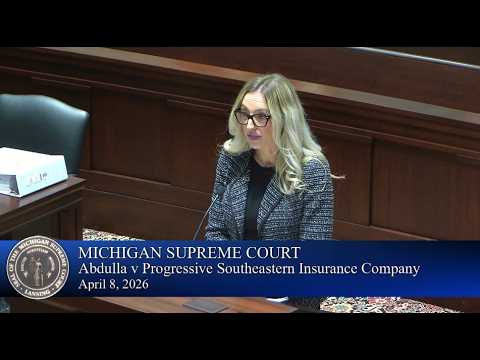
The Michigan Supreme Court heard oral argument in Abdullah v. Progressive Southeast Insurance on whether a truck driver who titled a commercial vehicle in a single-member limited liability company can qualify as an "owner" under Michigan's no-fault law and recover personal protection insurance (PIP) benefits.
Attorney Brianna Comolmes, arguing for the party opposing Abdullah, told the court that the panel majority reached the wrong result by allowing a driver who had exclusive use and possession of a truck but failed to insure it to obtain PIP. "Anyone could create a limited liability company, transfer vehicle title to it, and rely on another household member's insurance to pay for benefits," Comolmes said, urging the court to read MCL 500.3101 in light of the statute's purpose to prevent "free riders." She asked the court to focus on the statute's usage-based owner definition—"having the use of a motor vehicle under lease or otherwise for a period that is greater than 30 days"—and cited prior decisions (Art v Titan; Twitchel) to argue that proprietary or possessory use, not mere title, should control.
Justices pressed counsel on the meaning of the phrase "or otherwise" and posed hypotheticals (for example, how a UPS driver who regularly drives the same truck should be treated). Comolmes responded that the key inquiry is whether the driver exercised dominion and exclusive control—"possession" as defined in Black's Law Dictionary—citing record facts that the plaintiff alone drove, scheduled, maintained and directed use of the vehicle.
Opposing counsel Steve Hicks, representing Muhammad Abdullah, told the court the LLC is a separate legal entity and contended the limited liability company statute bars treating a member as having a proprietary interest in specific company property. "This is property of the LLC. It's titled in the LLC's name and that simply is not something they can get around," Hicks said, arguing that Abdullah never received a conveyance of personal-use rights and that his usage was always as an agent of the company.
Hicks acknowledged that accepting the defendant's reading could produce what he called "anomalous" results—for example, many single-member contractors who title trucks to LLCs—but he told the court that correcting such outcomes is the legislature's role, not the judiciary's. He also urged the court to read Twitchel narrowly, as addressing the 30-day timing question rather than eliminating the right-to-use inquiry.
Both sides asked the court to harmonize the no-fault act with the limited liability company act, but they proposed different starting points: Comolmes urged a usage-based route that could treat a sole user as an owner even if title is in an LLC; Hicks emphasized the separate-entity rule and argued the LLC statutory text should govern.
Throughout argument counsel cited MCL 500.3101 and discussed interplay with the limited liability company statute (referred to in argument as MCL 450.4504 section 2). They relied on, and debated the meaning of, precedents the parties raised, including Art v Titan, Twitchel, Ross v Auto Club and an unpublished Chima decision. The justices repeatedly questioned whether the factual pattern here—Abdullah's exclusive day-to-day control and lack of personal-use evidence—would permit treating him as an owner under existing precedents.
After roughly 15 minutes of argument per side and a period of questioning, the court announced the case would be submitted for decision; no opinion was issued from the bench.
The court record shows the immediate legal questions: whether the no-fault statute's owner definition reaches a member who had sole use and possession while title rested with an LLC, and if so whether the LLC statute nonetheless precludes treating a member as an owner. The court's decision will resolve which statutory framework governs PIP entitlement in similar single-member LLC contexts and could affect many independent operators who title commercial vehicles in small LLCs.
The case was submitted to the court for decision.