Get Full Government Meeting Transcripts, Videos, & Alerts Forever!
Get email alerts on the Building Codes topic
No spam. Unsubscribe anytime.
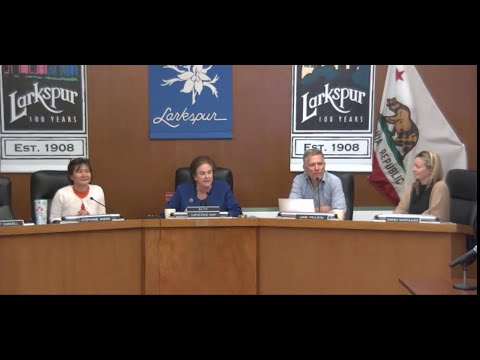
Larkspur adopts CalGreen Tier 1 building code amendments after marathon public hearing
Summary
After a lengthy public hearing with extensive resident comment, the Larkspur City Council adopted two ordinances (1088 and 1089) to adopt 2022 and 2025 CalGreen Tier 1 standards, citing a narrow window to submit required cost‑effectiveness studies to the California Energy Commission.
Assistant City Manager Shannon O'Hare told the council that a recent state legislative timing constraint created a limited window for jurisdictions to adopt 2022 and 2025 CalGreen Tier 1 building standards; she recommended moving forward to preserve the city’s opportunity to submit cost‑effectiveness studies to the California Energy Commission.
"The legislature has put us on a little bit of a time crunch," Shannon O'Hare said, explaining that the change in state law limits local ability to adopt statewide code updates until June 1, 2031 if the city does not act now. The staff presentation walked through the technical differences between the code cycles, the requirement to submit energy‑cost studies and how some CalGreen provisions may lack ready data at the 2025 cycle, meaning staff will follow up with the California Energy Commission on outstanding analyses.
Council members pressed staff on likely upfront costs and how rules would affect new construction versus remodels. The record included several technical references: staff noted that a remodel threshold—projects that replace more than 50% of a building—can be treated as new construction for purposes of electrification requirements, and that CalGreen adoption requires cost‑effectiveness documentation. Some council members cited an outside study that estimated roughly a 5.29% construction premium for voluntary green measures; staff and other council members replied that most rigorous studies show all‑electric new construction is cost‑competitive when construction‑system and lifecycle savings are included.
Public comment was extensive and divided. Students and residents urged adoption on climate and public‑health grounds, describing long‑term benefits and framing the ordinance as a “demand signal” for electrification. One online commenter, James Holmes, urged delay, arguing electrification risks higher bills and inequitable outcomes. After discussion, Mayor Way moved to pass both ordinances; the motion was seconded and was approved by voice vote with no opposition recorded.
The council’s action adopts Ordinances 1088 and 1089 (CalGreen Tier 1) as the city’s building‑code amendments. Staff said they will submit required documentation to the California Energy Commission, evaluate any CalGreen provisions that lack sufficient cost‑effectiveness data, and return with implementation guidance and any needed adjustments to minimize unintended barriers to housing development.