Get Full Government Meeting Transcripts, Videos, & Alerts Forever!
Get email alerts on the Instructional Time Model topic
No spam. Unsubscribe anytime.
Kyrene holds first public hearing on 2026–27 instructional time model; board to vote May 27
Summary
At a May 13 public hearing the district previewed a four‑part instructional time model that allows limited asynchronous or online instruction for extended absences, emergency closures and Kyrene online students; board will hold a second required hearing on May 27 and then vote.
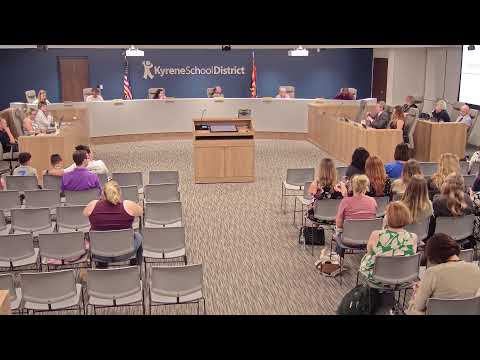
The Kyrene Elementary District held the first of two public hearings on May 13 to solicit feedback on a proposed instructional time model for the 2026–27 school year, required by state statute to account for remote learning and attendance reporting.
Director of Academic Equity and Excellence Amy Gingell described four scenarios that could be used districtwide: (1) asynchronous completion of learning activities when a student is absent for a week or longer (family‑initiated or school‑determined), (2) an independent asynchronous study option retained as a model for future programs, (3) participation in the district’s online learning program (formerly KBA) where teacher‑led online instruction and asynchronous modules combine, and (4) emergency remote instruction for short‑term building closures or public‑health events. Gingell explained attendance rules: students logging into teacher‑led online sessions are marked present, those completing asynchronous modules are marked present once work is confirmed by a teacher, and work not completed within 10 school days is recorded as absent.
Board members asked clarifying questions about limits on asynchronous duration and whether social‑emotional curricula can be delivered asynchronously. Gingell said duration is typically determined case‑by‑case by the school and family and that some curricula (for example, middle‑school SEL that relies on classroom discussion) may not be easily substituted.
During public comment, Corinne Inouye described acting and film work that requires children to be on set with a set teacher and requested that the model accommodate professionally supervised absences so that students’ on‑set learning is credited. Gingell said the model can be applied on a case‑by‑case basis and noted a second hearing is scheduled May 27, when the board will consider a vote.
What happens next: The board will hold the second required public hearing on May 27, at which a vote on the instructional time model is expected.