Get Full Government Meeting Transcripts, Videos, & Alerts Forever!
Get email alerts on the Ethics Governance topic
No spam. Unsubscribe anytime.
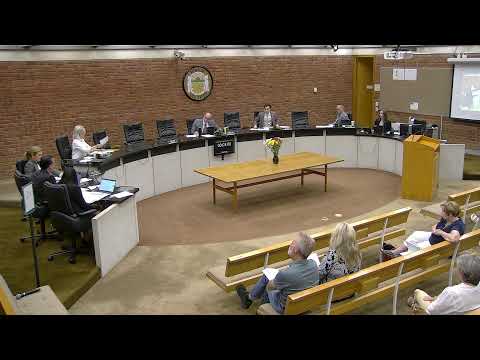
Town of Los Gatos council debates code-of-conduct limits for commissioners and temporarily suspends nonprofit restriction
Summary
At a study session the Town of Los Gatos reviewed proposed revisions to its council and boards/commissions code of conduct, heard residents warn the draft could chill commissioners' outreach, and unanimously approved a temporary suspension of a rule restricting commissioners from serving on certain nonprofit boards pending policy revisions.
The Town of Los Gatos Town Council reviewed proposed revisions to its council and boards-and-commissions code of conduct at a special study session and voted unanimously to temporarily suspend a restriction on commissioners serving on certain nonprofit boards while staff returns a clarified policy.
The council approved the temporary suspension after Council Member Risto moved to lift the restriction “until we can get that straightened out with the new policy,” a motion Vice Mayor Moore seconded. The clerk recorded five affirmative votes and the motion passed. The suspension applies to the provision that had limited commissioners’ participation on nonprofit boards that receive town funding; the council directed staff to bring revised language back for formal action.
The session focused on two recurring concerns: limits in the draft that would require prior approval for commission communications, and a reworked enforcement process for code-of-conduct complaints. Public commenters and some commissioners said the draft, as written, risked curtailing volunteers’ ability to gather information and participate in local oversight.
“I urge the town to revise the policy to protect commissioners’ right to speak and gather information,” said Jeffrey Blum, a member of the Community Health and Senior Services Commission speaking on his own behalf. Blum argued the draft’s preapproval language could constitute “a constitutional prior restraint” and said commissioners retain First Amendment protections: “Appointed officials may speak, inquire, and seek information so long as they don't claim to speak officially for the town.”
Eleanor Yik, identified as chair of the Community Health and Senior Services Commission but speaking as a resident, told the council she was concerned about enforcement procedures and practical effects on commission work. “If commissions are unable to gather data, assess it, and make recommendations, why have them at all?” she asked, urging clearer notice procedures for complaint subjects and modifications to communication restrictions.
Staff told the council the alternate draft aims to preserve commissioners’ ability to gather facts while clarifying when they may speak as individuals and when they are authorized to represent the town. The manager described the work-plan process as the mechanism for authorizing official outreach: a commission activity approved on its council‑sanctioned work plan would be deemed authorized and staff could provide a letter or materials to help commissioners identify themselves in the field.
On enforcement, staff outlined a shift to intake through the town clerk with a five‑day notification to all council members and two tracks: an informal peer‑to‑peer route to resolve lesser matters, and a formal path that requires two council members to place a complaint on a future agenda for full council consideration. Staff said complaint materials would generally be public records unless an exception applied.
Council members debated trade-offs. Some favored the transparent, council-centered approach to avoid staff-led investigations; others warned a low threshold for agendaizing complaints could enable “weaponization” of the process on a split council. Members also discussed whether language about “community events” should be removed to avoid constraining the routine practice of describing council actions at public gatherings; the council directed staff to delete that bullet from the draft.
Council members also asked staff and the town attorney to align the policy with state law and FPPC (Fair Political Practices Commission) guidance on conflicts of interest and recusal, rather than requiring council approval for every outside board affiliation. The town attorney noted state rules and government-code doctrines that govern incompatible offices and financial conflicts.
Next steps: staff will return a revised draft that incorporates the council’s direction — including removing the community-events bullet, tightening or striking section language on nonprofit board service in favor of FPPC-aligned recusal language, and clarifying the work-plan authorization and enforcement flow. For now the council approved a temporary suspension of the nonprofit restriction so commissioners' existing service and outreach are not interrupted while the policy is refined.
The study session concluded with the manager advising that existing commission policies would continue to apply until the council adopts a new resolution; the mayor then adjourned the meeting.