Get Full Government Meeting Transcripts, Videos, & Alerts Forever!
Get email alerts on the Photo Enforcement topic
No spam. Unsubscribe anytime.
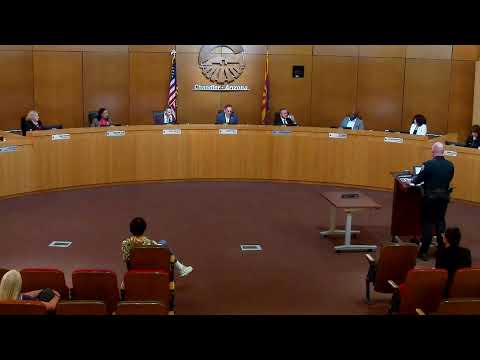
Chandler council questions privacy, data safeguards in proposal to extend Vera Mobility photo‑enforcement contract
Summary
City staff asked the council to extend Chandler’s photo‑enforcement agreement with Vera Mobility for three years while state rules evolve; council members raised privacy, data‑breach, calibration and contract‑language concerns and asked for more information before Thursday’s vote.
Assistant Chief Matt presented a request on Feb. 23, 2026, for a three‑year extension of Chandler’s existing photo‑enforcement agreement with Vera Mobility (formerly American Traffic Solutions), saying the short extension would give the city time to monitor evolving state legislation.
Matt told the council the program covers 12 intersections monitored by 17 cameras that enforce red‑light and speed violations, and that the city’s approach is “safety over profit.” He described operational safeguards: a trained Chandler PD employee human‑reviews every citation before it is issued; data and images are processed under contractual controls; and Vera Mobility provides expert‑witness testimony for contested citations at no extra cost. He said the proposed contract ceiling for the three‑year extension is $1.5 million (about $500,000 per year) and that the city aims to keep the program revenue‑neutral, reinvesting any surplus into traffic safety initiatives.
Council members pressed staff on privacy and data‑security protections. Councilmember Harris called out a perceived “Big Brother” element and said many residents have raised privacy concerns. Harris asked whether the cameras record people walking by and whether the system uses facial recognition or other broad surveillance tools; staff replied that the devices record video of a violation at the moment it occurs and that the program is not used for automated facial recognition (AFR) or third‑party, non‑law‑enforcement sharing. Staff further said the cameras can record bystanders if they are in the frame at the moment of a violation but that only imagery associated with an observed violation is forwarded for citation processing.
Harris and other council members also sought the vendor’s breach history, calibration schedule and contract exit provisions. Staff said the contract contains notification and indemnity obligations and that insurance and contractual remedies are in place; one city official said, based on prior experience with the vendor, he recalled no data breach but staff committed to obtain vendor records and provide the requested documents before Thursday’s meeting.
Councilmembers asked whether the system is quota‑driven; staff said it is not. The presentation included program effectiveness data: Matt said injury collisions at camera intersections were down roughly 37.6% over a five‑year comparison and that combined citywide collisions declined about 4.2% over the same period. Staff noted the program has been in use since 2007 and that the extension is intended as a short bridge while state law is unsettled.
Several council members said they want more time to review contract language and privacy protections before approving an extension. Staff said the contract can be terminated for convenience and that the city would only owe unamortized installation costs if it canceled.
Next steps: staff committed to provide the contract, calibration/maintenance schedules, any vendor breach history, and additional privacy documentation to council members before the scheduled Thursday meeting, where council expected to consider formal action.