Get Full Government Meeting Transcripts, Videos, & Alerts Forever!
Get email alerts on the Pacific Sardine topic
No spam. Unsubscribe anytime.
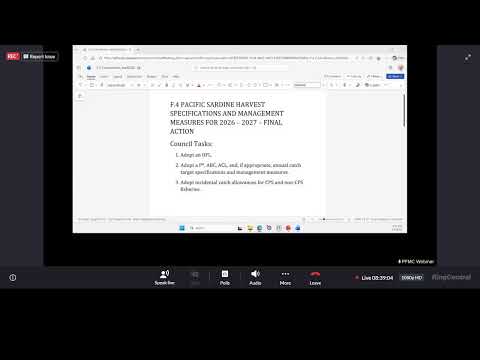
Pacific Council adopts sardine 2026–27 specs: ACL set at 2,200 t with ACT 2,100 t and accountability triggers
Summary
With no new stock assessment in 2026, the council rolled over the SSC's prior OFL and adopted conservative ABC/ACL/ACT values and accountability measures to limit incidental sardine mortality while an EFP and survey work continue. The council approved a 520‑ton EFP allocation.
The Pacific Fishery Management Council adopted harvest specifications and management measures for the northern subpopulation of Pacific sardine for the July 1, 2026–June 30, 2027 fishing year on April 9.
Because NMFS did not complete a new stock assessment in 2026, the SSC recommended rolling over the 2025 OFL of 4,645 metric tons and using a conservative category‑3 sigma (2.0) to derive ABC = 3,613 metric tons. Management teams recommended a conservative ACL of 2,200 metric tons and an ACT of 2,100 metric tons. Council members adopted those values, paired with accountability measures and an incidental‑landing framework.
Details: the council set the P* (probability) at 0.45 for ABC calculation and specified the following accountability measures: a 20% incidental landing limit for CPS fisheries while the ACT is below the trigger; if the ACT (2,100 t) is attained, a one‑metric‑ton per‑trip upper limit applies to all CPS fisheries and a two‑metric‑ton per‑landing allowance applies for non‑CPS fisheries until the ACL is reached. The adopted specifications also accommodate a 520‑metric‑ton allocation for an approved EFP to collect biological data.
Why the council acted this way: SSC members and management teams said rolling over the OFL was the appropriate interim approach in the absence of a new assessment. The SSC noted that the survey-based northern-subpopulation biomass estimate (from the 2025 IWCPS) was higher than the assessment-based H1+ biomass used in the ACL formula, but because the assessment and age‑structured estimate were not updated, the SSC opted to roll forward the assessed OFL and use conservative buffers.
What comes next: the council approved the specifications for 2026–27 and asked staff and science centers to continue survey calibration, to pursue work on stock structure, and to return updated analyses if new assessment work or methodological calibrations alter the biomass or productivity inputs.