Get Full Government Meeting Transcripts, Videos, & Alerts Forever!
Get email alerts on the Property Tax Administration topic
No spam. Unsubscribe anytime.
Douglas County staff outline property-tax calendar and state utility valuations ahead of June certification
Summary
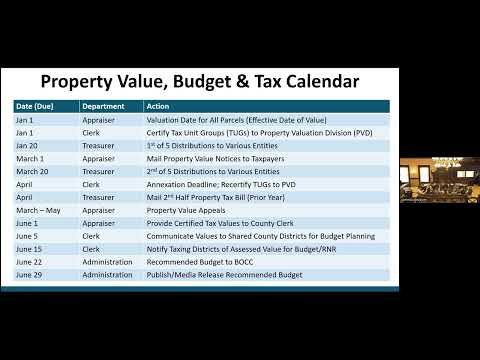
County staff told commissioners on Feb. 25 that roughly 42,000 property value notices will be mailed and that the appraisal roll certification is scheduled for June 1, a timing pressure that affects budgeting for cities, schools and special districts.
Douglas County staff briefed commissioners on Feb. 25 on the county—property tax billing timeline, the effect of state-handled utility valuations and the operational demands of preparing value notices and certifying the appraisal roll.
Brad Eldridge, county appraiser, said the county will mail roughly 42,000 value notices as the first step in the annual cycle and that he expects to certify the appraisal roll on June 1. "I just sent out about 42,000 value notices. Actually they're going to be hitting the mail tomorrow," Eldridge said, underscoring the short windows staff face as appeals and revenue-neutral calculations move concurrently with budget work.
Why it matters: Local governments rely on timely, accurate tax data to set mill levies and budgets. Staff told commissioners the county acts as a fiduciary, collecting and distributing tax revenue for cities, school districts and special districts; Brooks, finance manager, said the team issued nearly $279 million in tax statements in November to support those jurisdictions.
Staff described multiple, overlapping timelines: while the county finalizes last year's billing cycle and processes appeals, it is also preparing next year's valuation work and the revenue-neutral calculations that influence mill-levy decisions in the fall. The presentation noted that state-managed utility valuations (for example, a large utility identified as EverG) arrive on a tight schedule in early June and can materially affect the local tax base. "It is appraised and assessed by the state and so their staff sets the values for that and we receive that around June," Eldridge said, adding utilities can account for approximately 8—10% of the county's tax base.
Staff also warned that the county's work is sensitive to legislative change. When statutes change, sometimes retroactively, the tax team must reprogram systems and add internal controls to stay aligned with state requirements.
Next steps: No votes were taken at the 4:00 p.m. work session; commissioners recessed to a business meeting at 5:30 p.m. Staff committed to provide additional information as requests arise during the upcoming budget cycle.
Ending: The commission recessed the work session until the scheduled business meeting; commissioners will consider any formal actions at that later session.