Get Full Government Meeting Transcripts, Videos, & Alerts Forever!
Get email alerts on the Budget topic
No spam. Unsubscribe anytime.
Morrisville previews FY27 budget as council debates ONI study, town‑center activation and public‑safety requests
Summary
Town staff presented a $54.2 million base budget and proposals for roughly $8.6 million in new requests, sparking council debate over a $150,000 ONI small‑area plan, $500,000 in held one‑time items, police equipment and how to account for widespread property‑tax appeals.
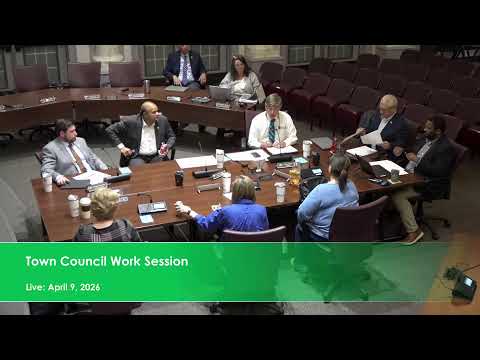
Town Manager Brandon Zuda told the Morrisville Town Council at its April 9 work session that the materials presented were a preview, not a recommended FY27 budget, and asked the council for guidance as staff prepares a recommended proposal for April 28. Zuda said the town has limited new revenue—"This year the penny is worth $970,000. Next year we estimate the penny to be $971,000,"—and that appeals from the FY25 revaluation have largely offset expected growth.
Staff said the town received $13.3 million in budget requests and highlighted about $500,000 in previously appropriated but held one‑time items that staff recommends releasing. Finance staff member Byron listed the held items as an ADA pedestrian accessibility study (~$65,000), additional park security cameras (~$67,000), police digital‑forensics capability and equipment (roughly $80,000), pool shade and athletic scoreboard repairs, smart‑sensor pilot funding, greenway maintenance and other one‑time tools, and a $150,000 line for an Office/Industrial (ONI) small‑area plan.
Council members pressed staff on priorities and limits of municipal authority. Council Member Garamel questioned spending $150,000 on a study whose outcomes the town may not be able to implement under recent state law: “I don't know why the town is funding something where the outcome is not something we can impact,” she said, urging staff to secure private partners before committing taxpayer dollars. Staff and the economic development director said a smaller gap analysis (estimated $60k) could still provide market information and that convenings with property owners might be attempted first.
Police equipment requests drew particular scrutiny. Council Member Robati said the package of rifles, drones and other gear “sounds paramilitary to me.” Police leadership defended the plan, saying the department seeks to assign qualifying patrol rifles by serial number so officers are trained on the exact weapon and can secure scenes from greater standoff distances when needed. A police representative also said the drone request replaces an aging unit and adds a second drone with complementary capabilities; staff framed digital‑forensics purchases as a way to reduce outsourcing and speed investigations.
Appeals from the county revaluation were a recurring theme. Byron told the council the scale of appeals has been unusually large and volatile—"we saw 1.5 billion worth of appeals"—and staff said the uncertainty has led to conservative revenue projections. Staff emphasized available capacity tools: repurposing approximately $1 million in base‑budget savings, limited use of reserves for one‑time items, bond proceeds already set aside for land acquisition (about $3 million remaining), and the potential for grants or sponsorships.
Town Center activation and timing also prompted debate. Staff proposed half‑year positions and operating funding to staff the town green and related town‑center facilities as they come online; council members asked staff to firm up schedules and warned against hiring expensive recurring positions before facilities open, suggesting timing adjustments and external sponsorships to offset costs.
On the fiscal choices front, staff presented options to close an approximate $1.0 million gap between requested additions and conservative revenue projections: reduce or defer recurring items (for example, pause a COLA, defer some positions or capital replacements), trim one‑time investments such as EV equipment or shuttle stops, or consider a targeted tax increment (the manager illustrated that a single penny of property tax equals roughly $971,000 in revenue). Council members were divided; several stressed protecting reserves and public‑safety capacity, others advocated incremental, predictable increases to avoid larger catch‑up steps later.
The session concluded with staff committing to publish a detailed FAQ and supplemental materials (cost‑benefit and recurring‑vs‑one‑time breakdowns) and returning for additional work sessions before any recommended budget adoption. The meeting adjourned after a unanimous voice vote.
Ending: Staff will bring a recommended budget on April 28 and additional work sessions are planned for council review and public engagement before any final decision.