Get Full Government Meeting Transcripts, Videos, & Alerts Forever!
Get email alerts on the Transportation Levy Programs topic
No spam. Unsubscribe anytime.
Seattle unveils three levy programs to fund neighborhood safety, public plazas and low‑pollution pilots
Summary
SDOT told the council committee it will use 2024 levy funds to launch three programs—Neighborhood‑Initiated Safety Partnership Program (NISPP), People Streets/Public Spaces (PSPS), and Low Pollution Neighborhoods (LPN)—with initial projects and pilots in 2026–27 and a focus on equity and place‑based engagement.
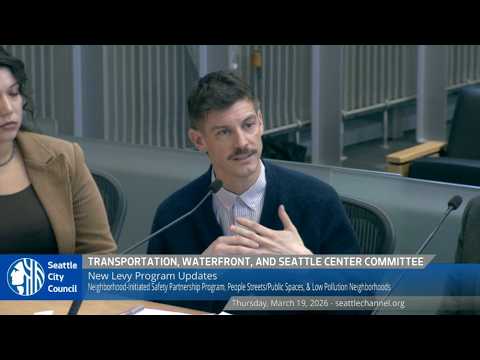
Seattle’s Department of Transportation presented detailed plans March 19 to use 2024 transportation‑levy funding to start three new programs aimed at improving neighborhood safety, creating people‑centered public spaces and advancing coordinated low‑pollution pilots.
Chair Rob Saka opened the committee meeting by saying the effort must balance one of the region’s largest infrastructure investments with protections for small businesses and neighborhoods. “I can plan for change, I cannot plan for uncertainty,” Saka said, urging the city and partner agencies to provide clarity and support for affected small businesses.
SDOT officials described each program and early delivery plans. Julia Jannon‑Shields, the department’s neighborhood‑initiated safety partnership lead, said NISPP received $39.5 million from the levy to build at least 10 co‑created, place‑based projects—sidewalks, crossings and traffic‑calming measures—targeted to neighborhoods with demonstrated safety and equity needs. She said SDOT selected 19 initial projects across 12 neighborhoods to advance in 2026–27 and will prioritize projects that complement sidewalk investments and reduce repeat community requests.
Ian MacEk, program manager for People Streets/Public Spaces, said the levy provides the first consistent, citywide funding to create plazas, tactical activations, seating and pedestrian‑oriented capital projects. MacEk said the program is designed to be flexible—ranging from large capital investments to small, nimble community‑driven improvements—and will rely on co‑creation with local business districts and community organizations.
Jaya Eyzaguirre, who directs the Low Pollution Neighborhoods work, said LPNs will be coordinated, neighborhood‑level efforts to reduce transportation pollution and strengthen climate resilience. SDOT announced three initial pilots—Lake City, Capitol Hill and a combined South Park/Georgetown approach—and said 2026 will focus on planning and partnership building, with design in 2027 and phased implementation thereafter.
Councilmembers pressed SDOT on how projects will be prioritized and how the department will incorporate past outreach. Vice Chair Rinck and others asked about the equity criteria and the department’s prioritization approach; SDOT answered that the new place‑based hardship model draws on prior outreach (including walking tours and existing community plans) and emphasizes relationship building in neighborhoods without strong existing community‑based organizations.
Several public commenters and neighborhood representatives at the hearing urged more clarity on how to apply for People Streets projects and how low‑pollution strategies will interact with proposals for car‑free streets. SDOT said the levy funds will allow the department to scale pilot work across neighborhoods, track metrics and align with city climate goals.
The committee did not take formal action but directed SDOT to continue community engagement and provide updates as projects move from planning to design and construction. The presentation concluded with multiple councilmembers expressing interest in ensuring the programs reach underinvested neighborhoods and in getting periodic status reports as projects reach 30% design and beyond.
The committee moved next to an anti‑displacement roundtable and Sound Transit discussion.