Get Full Government Meeting Transcripts, Videos, & Alerts Forever!
Get email alerts on the Superintendent Search topic
No spam. Unsubscribe anytime.
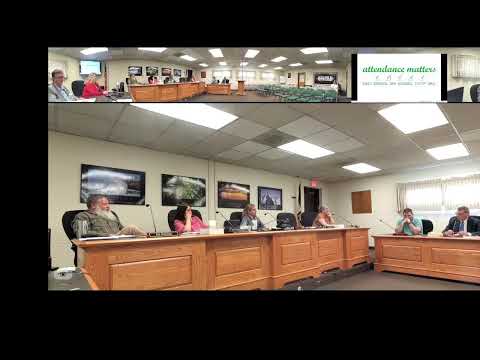
Randolph County board lays out fast-track superintendent search ahead of June 1 deadline
Summary
At a special work session the Randolph County board discussed options to fill the superintendent vacancy, noting a June 1 statutory deadline for setting term and base salary, the new Senate Bill 694 residency change effective June 7, and a recommended three-week application window and modest advertising budget.
At a special work session, the Randolph County board discussed a plan to fill its county superintendent vacancy and steps to meet a statutory June 1 deadline to set the incoming superintendent’s term and base salary.
Dr. McCall, who led the session’s presentation, told the board to note two dates: June 1, 2026 — the deadline under state law for adopting the superintendent’s term length and base pay — and June 7, 2026, the effective date of Senate Bill 694, which Dr. McCall said removes the county residency requirement for newly appointed superintendents. "That law . . . says there is no residential requirement," he said, while cautioning boards should not rely solely on any interpretation to bridge the six-day gap between the two dates.
Why it matters: the June 1 deadline constrains how quickly the board must finalize contract basics, while SB694 changes the pool of eligible candidates by allowing appointment of individuals who do not reside in the county or a bordering county once the law takes effect.
Search options and preferred approach
Dr. McCall outlined four common approaches: direct appointment of an internal or known candidate, a traditional open search with advertised applications, a customized search using an outside organization to manage logistics, and a national search. He cautioned that national searches can be costly and often draw candidates unfamiliar with West Virginia’s statutory and operational constraints.
He recommended the customized option as a practical middle path: an outside organization such as the West Virginia School Boards Association (WVSBA) could handle advertising, clerical work and screening logistics without recommending a candidate, preserving neutrality while reducing the board office’s workload.
Applications, screening and timeline
The board was advised to require a resume/CV and a short supplemental questionnaire rather than an online application form, and to allow a roughly three-week application window. Dr. McCall recommended structured interviews — about 45–60 minutes with standardized core questions — as the primary screening tool and said that the board can add clarifying follow-up questions after initial responses.
Credentials and background checks
Board members were told to consult the state certification office (Dr. McCall cited a contact, Robert Hagerman) to verify minimum credentials and to request the department’s background-check information. "They can point out who is already qualified or has blemishes," Dr. McCall said, describing that review as a routine step before appointing a superintendent.
Budget, advertising and association fees
Dr. McCall advised advertising through state channels — the Press Association, the Charleston Gazette-Mail and outlets like Metro News — and targeted distribution to educator groups (WVESA/WVASA). He estimated advertising could be done for roughly $1,200–$1,500 and suggested the board place a modest cap on the agenda (for example, $2,000) so vote approval would authorize spending without exceeding the limit.
He described an association fee model of travel reimbursement plus approximately $750 for staff time to support the customized search, and recommended the board place on its next regular agenda a voting item to authorize advertising and, if desired, contract with the association for search services.
Legal duties and contract items
Dr. McCall emphasized the superintendent’s statutory responsibilities and cited relevant code sections the board will need to reflect in position materials and contract language. He advised including the county benefits package in the notice of vacancy, specifying required credentials, and, if desired, clarifying allowable virtual work days in the superintendent’s contract.
Public input and election-year considerations
Board members asked how to involve the public and how the upcoming election cycle could affect the process. Dr. McCall described options such as public surveys to gather desired candidate characteristics and noted timing considerations around the May primary; he emphasized that public input should inform but not bind the board’s final decision.
Next steps and administrative contact
The board designated Mr. George as the point of contact to coordinate with the association and central office staff to produce a notice of vacancy and advertising costs. Dr. McCall said the association would provide timeline templates and assistance compiling applicant materials for the board.
Procedural note
The session concluded with a motion to adjourn moved by Janie and seconded by Sherry; the presiding official recorded the vote as 4–0 in favor with a named member absent, and the meeting adjourned at 6:43 p.m.
What’s next: the board plans to place an agenda item at its next regular meeting to authorize advertising (with a not-to-exceed amount) and to decide whether to contract with the association to manage the customized search process.