Get Full Government Meeting Transcripts, Videos, & Alerts Forever!
Get email alerts on the Juvenile Sentencing De Facto Life topic
No spam. Unsubscribe anytime.
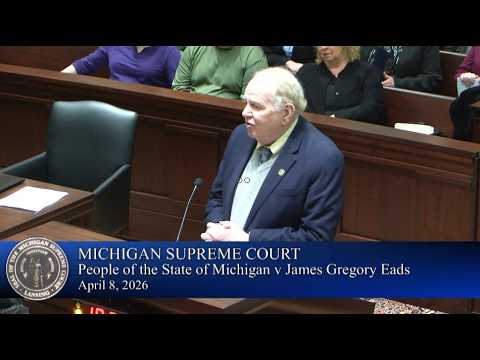
High court argued over whether 50–75-year term for juvenile is a 'de facto' life sentence
Summary
In oral argument, advocates and an amicus urged the court to treat a 50–75-year sentence imposed on a juvenile as the functional equivalent of life, citing Stovall and Miller; prosecutors urged deference to legislative sentencing choices and Milbourn proportionality review.
The Michigan Supreme Court heard competing arguments over whether a 50-to-75-year sentence imposed on a juvenile convicted of second-degree murder functions as a de facto life sentence and therefore requires resentencing.
Tim Broffman, representing Kym Worthy, the Wayne County prosecutor, told the court that the defendant’s conduct and the sentencing judge’s findings justified the term the court imposed. "In this case, uh, almost 34 years ago, the defendant shot and killed Eric Incate," Broffman said, recounting the conviction and the sentencing judge’s reliance on victim impact testimony and the defendant’s conduct in youth facilities.
Broffman argued that issues about how juveniles generally should be sentenced are normative policy questions for the legislature rather than for this court to resolve. He urged that proportionality review under Milbourn should control this case, noting the court of appeals and this court previously addressed the sentence in prior proceedings.
Philip Komorski, who represents the defendant, said the sentence imposed here is the practical equivalent of a life sentence. "The judge at the time of sentencing noted that a life sentence would be a lot easier than if I impose this 50-year harsh sentence," Komorski said, contending the trial judge’s statements showed intent to keep the defendant incarcerated for life despite using a term of years.
Komorski and an amicus (Criminal Defense Attorneys of Michigan) urged the justices to apply Stovall (and related juvenile-sentencing precedents) to require resentencing that affords a meaningful opportunity for release. Komorski pointed to prior analyses treating a roughly 39-year threshold as a federal benchmark for a de facto life sentence and argued that the sentencing here exceeded ranges applicable to juveniles.
Counsel and the justices also debated the practical meaning of parole eligibility. A justice observed that although an "out date" (an early parole eligibility date) could exist on paper, parole rates and good-time credit practices can make that date effectively meaningless. Komorski acknowledged that being eligible for parole is not the same as being likely to receive it, and he argued that the combination of the minimum and the practical likelihood of release supports treating harsh term-of-years sentences for juveniles as constitutionally suspect.
Menlo, appearing for the amicus Criminal Defense Attorneys of Michigan, urged the court to view Stovall as the most direct path to relief and argued Miller and Stovall together undermine earlier proportionality rulings. Menlo also invoked Michigan Court Rule MCR 76.508(D)(2) to argue the change in law should allow relief without requiring a finding that Boykin is retroactive.
The justices questioned how to draw a workable line—whether to focus on the minimum, the maximum, or a combined metric—and raised concerns about administrative burden and reliance interests if broad retroactivity were applied. Menlo responded that previous opinions (Pool) weighed those concerns but ultimately applied retroactivity in light of the constitutional stakes for juveniles serving unduly harsh terms.
After brief rebuttal, the court submitted the case.
The argument centered on two competing approaches: prosecutors asking courts to defer to legislative sentencing choices and to apply Milbourn proportionality review, and defense and amicus counsel asking the court to treat extreme term-of-years sentences for juveniles as the functional equivalent of life under Stovall and Miller, entitling affected people to resentencing or a meaningful opportunity for release. The court took the matter under submission.