Get Full Government Meeting Transcripts, Videos, & Alerts Forever!
Get email alerts on the Public Works Infrastructure topic
No spam. Unsubscribe anytime.
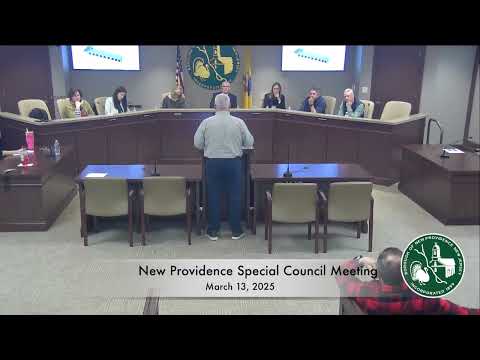
New Providence hears $4.5M plan to replace aging public works garage
Summary
A Department of Public Works representative told a public meeting that the borough’s nearly 80-year-old public works garage is structurally failing and proposed demolishing and rebuilding it with a pre-engineered Butler Building under a State Co‑Op turnkey contract; estimated construction is seven months and the high-end cost is about $4.5 million. Council heard questions but took no formal vote.
Mr. Lynch, representing the Department of Public Works, presented a plan to demolish and replace the borough’s aging public‑works garage with a pre‑engineered, low‑maintenance building supplied through a State Co‑Op turnkey contract. He told the meeting the existing masonry structure has failing cinder‑block walls and configuration limits that prevent modern trucks from operating safely and efficiently.
The plan would rebuild the facility on roughly the same footprint because flood‑plain limits and utilities constrain expansion. Mr. Lynch said the contractor would provide design, demolition, construction and fit‑out under a single contract and that the borough already has three 40‑foot storage containers on site to serve as temporary secure storage. “We can’t do anything else on this property so the map what you really need to know … is there’s flood plains… our footprint is what we’re limited to,” he said.
Mr. Lynch described structural reasons the old building cannot be saved: additions added over decades created mismatched foundations and a central steel beam and deteriorating cinder‑block walls that limit truck clearance and threaten long‑term integrity. “This building’s almost 80 years old and there’s wear and tear,” he said, adding that the pre‑engineered Butler Building would require new spread footings because its steel trusses concentrate loads at discrete points.
The proposed replacement would include ADA‑compliant locker and ready rooms, continuous epoxy‑finished garage floors for safety and equipment movement, improved insulation, radiant heating for high‑bay areas and LED shop lighting. Mr. Lynch said these features would reduce maintenance and increase productivity by eliminating time lost shuffling vehicles into and out of constrained bays.
On procurement, Mr. Lynch said the borough would use a State Co‑Op turnkey vendor and noted the manufacturer’s approved installers handle on‑site assembly; he said the approach avoids separate architect and general‑contractor procurements and is competitive on a per‑square‑foot comparison. He estimated the high‑end turnkey cost at about $4.5 million, inclusive of demolition and design: “On the high end right now we’re at 4.5 million,” he said.
Construction sequencing and temporary operations were a focus of council questions. Mr. Lynch said the contractor expects about seven months for on‑site construction and described packing operations, use of a temporary Quonset‑hut tent spanning three containers to allow covered work, and reusing some existing switchgear and backup generator arrangements to minimize utility disruption. He also said the borough could use a nearby, newer building for limited office functions during construction with modest renovations and that porta‑potties would be provided for workers.
Council members and attendees pressed on flood risk and elevation, vehicle lifts and long‑term space needs. Mr. Lynch said grading and a retaining wall would raise portions of the lot by about two feet near the salt shed and that portable certified lifts would be discussed with vendors. He confirmed the current garage lacks a fire‑suppression system, calling that “another reason for doing the project.”
There was general public appreciation for DPW staff and support for replacing the outdated facility, but the council did not take a formal vote on the project at this meeting. The chair moved to close public comments, the motion was seconded and approved by voice vote.
Next steps: the presentation will inform future budget and procurement work; the council did not authorize construction at this meeting and no binding contract award was made.