Get Full Government Meeting Transcripts, Videos, & Alerts Forever!
Get email alerts on the School Construction topic
No spam. Unsubscribe anytime.
Seymour schedules Oct. 9 referendum on $60 million Bang Elementary School project as residents weigh costs and site concerns
Summary
Seymour will ask voters on Oct. 9 to approve a $60 million appropriation to build a new Bang Elementary School, with the town expected to finance up to $20 million after an estimated 66.6% state reimbursement; supporters say new construction avoids disruptive modular classrooms and addresses safety and special-education space, while residents raised questions about site elevation, long-term costs and local labor involvement.
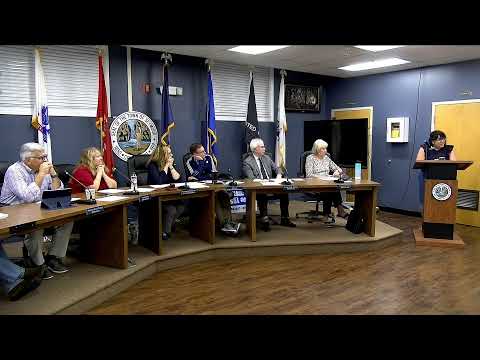
Seymour officials and residents on Sept. 16 reviewed a proposal to appropriate $60 million to construct a new Bang Elementary School and scheduled a referendum on the question for Oct. 9, 2025.
Town Moderator Kurt Miller read the official warning announcing the special town meeting and said the financing plan contemplates issuing bonds or notes not to exceed $20 million. "With the assumption that we would receive that 10% additional rate, the state of Connecticut would be reimbursing the town for 66.6% of the costs," Miller said, presenting examples of estimated debt-service and mill-rate impacts.
The building committee and its architect urged voters to approve new construction after an analysis found a new building could be less expensive than renovating the 1954 structure. "The estimates came in that to build a new school would be less expensive than to renovate the existing school as new," said Fred Stannic, co-chair of the Bang Elementary School Building Committee.
Michael Dosaso of Antonazi Associates, the project's architect for preliminary plans, explained the state reimbursement logic: renovation typically carries a higher base reimbursement than new construction, but a 2023 change allows an additional 10% when new construction is demonstrably less expensive, effectively equalizing the rate for this project. "The state actually passed legislation, I believe in 2023, which permits an additional 10% be applied to the project," Dosaso said.
Using the committee's figures, Miller said a $60 million project with an assumed 66.6% reimbursement would leave roughly $20 million to the town. He provided a worked example for context, noting that estimates assume current interest rates and could change: "If you did that same assumption ... that family would pay $198 a year" under the new-school scenario versus about $188 under the $15 million renovation estimate, he said.
Supporters at the meeting stressed student safety, program space and long-term value. Rebecca Bennett, a building-committee member who works in the school, described inadequate learning spaces and special-education constraints: "We have students working in the hallway... Some of these students ... trying to put them in a portable trailer to learn for two years ... the last thing we need is to put them two years further behind," she said.
Local business owners and residents argued state aid and long-term benefits justify the investment. "The state of Connecticut is going to pay two big chunks of this and it's going to be a great asset to the town," said building-committee member Andy North, a local business owner.
Questions and concerns focused on cost assumptions, site engineering and use of local labor. Resident Tony Shar asked for concrete numbers and whether multiple design options were evaluated. Ed Zhaul, who supported a new school in principle, warned about the planned site elevation and water-table risk, saying, "You're going to have water problems in that basement." Jay Pena, a union carpenter apprentice, urged the town to explore apprenticeship or union-trade involvement and referenced prevailing-wage rules under statute 31-52.
Committee members said only conceptual plans and state specifications are ready now; final plans and architect selection will follow a successful referendum. Fred Stannic said the project is being designed so students could remain in the existing building while the new school is built on the field and then move en masse to avoid multi-year displacement in modular classrooms.
Organizers also announced voter resources and outreach: community walkthroughs are scheduled for Sept. 24 and Sept. 29, Zoom Q&A sessions for Oct. 2 and Oct. 7, absentee ballots will be available, and voting will take place Oct. 9 at the Seymour Community Center between 6 a.m. and 8 p.m., Nicole Harriet Mucula of the Bang School Rebuild Alliance said.
The special town meeting adjourned and the appropriation resolution was set to appear on the Oct. 9 referendum ballot; no final decision was made at the Sept. 16 session.