Get Full Government Meeting Transcripts, Videos, & Alerts Forever!
Get email alerts on the Transportation Infrastructure topic
No spam. Unsubscribe anytime.
Atwater council pauses east segment of Fruitland Avenue project and orders contract review after residents protest traffic circles
Summary
After more than an hour of testimony from Fruitland Avenue residents, the Atwater City Council voted unanimously to pause construction on the east segment of the Fruitland Avenue reconstruction to re‑engineer plans that would remove three traffic circles and 12 choker islands and to open a review of the engineering consultant’s outreach obligations.
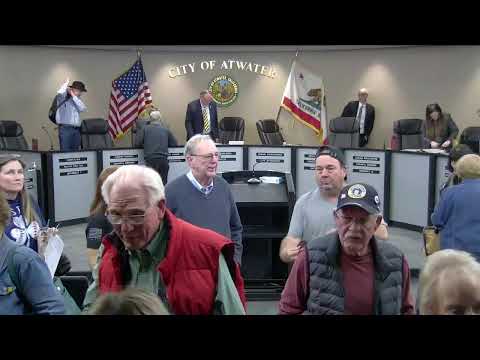
Atwater — The Atwater City Council on March 10 voted 5–0 to pause construction between Winton Way and Schaefer Road on the Fruitland Avenue Phase 3 reconstruction and to initiate a formal review of the contract performance of VBH (the project’s design consultant), after residents raised concerns about three proposed traffic circles and 12 choker islands.
Councilmember Kalisa Rochester moved the combined action, saying the council should check whether the consultant met its outreach obligations and give staff time to rework designs; the motion was seconded by Councilmember Ambre and passed unanimously. Mayor Nelson called the vote after lengthy public comment and council discussion.
The decision follows a staff presentation by City Manager Chris Holmes and consulting engineers, who said the plan dates to 2016 and that Phase 3 is a comprehensive reconstruction intended to address pavement, drainage, and pedestrian safety. Holmes outlined two options for council direction: continue the approved plan (the default) or pause the east segment to engineer out the traffic circles and choker islands and identify supplemental funding. Holmes told the council that, while earlier estimates put re‑engineering costs at $500,000–$750,000, an updated breakdown lowered the figure to about $300,000–$450,000 and that initial engineering work could begin under a separate authorization of roughly $60,000.
VBH contract engineer Michael Hayes confirmed he is a part owner of VBH, the firm that designed the Fruitland plans and which the city contracted in 2016. "Yes, I am a part owner of the company," Hayes said when asked to disclose the relationship. City Manager Holmes had introduced Hayes as the city’s contract engineer while noting VBH is the contracted consultant.
Traffic consultant Jose (the city’s contracted traffic engineer) defended roundabouts and chokers as traffic‑calming options, noting they do not require stop‑sign warrants and that roundabouts generally reduce collision severity. A Fire Department representative said roundabouts can slow emergency vehicles slightly but, when designed for emergency access, do not cause drastic response‑time delays.
Residents who spoke during a long public‑comment period urged the council to remove the roundabouts and chokers, saying the features would reduce parking, lower property values, intrude on privacy, complicate driveway access and potentially slow emergency response. "This project is unanimously opposed by these residents," Roger Wood told the council, summarizing frequent testimony that outreach and notice were inadequate. Multiple residents asked the council to consider alternatives such as speed humps, enhanced signage or fewer, smaller measures.
Several speakers alleged the outreach deliverables in VBH’s contract were not completed or documented. VBH staff said the city directed outreach be handled via a town‑hall meeting and large exhibits instead of the door‑to‑door approach included in the original scope and that meeting notes exist but would need to be located. During the meeting staff acknowledged an absence of a written amendment to the outreach portion of the 2016 contract and said city records would be reviewed.
Construction manager Brian Kroger told council that design revisions could be prepared in roughly two to four weeks depending on scope, but that pausing work or demobilizing the contractor could risk losing crews and add a month or more to the schedule. Staff recommended continuing work where impacts are limited (for example, the west segment in front of the high school) while pausing work on the east segment between Winton Way and Schaefer Road.
Holmes and staff also outlined funding: Measure V local sales tax revenue, one‑time ARPA funds used earlier in the program, Local Transportation Fund allocations and regional funds such as RSTP and SB‑1. Holmes said any supplemental funding to cover re‑engineering costs would require a future council appropriation and could affect other planned projects.
The council’s motion directs staff to pursue re‑engineering that excludes the circles and choker islands on the east segment, to start preliminary engineering work, and to bring back a contract amendment and budget adjustments as necessary. The motion also directs a formal review of VBH’s performance specifically related to public‑outreach obligations; the city attorney noted such a review must consider when any alleged oral directions may have occurred and whether the statute of limitations or equitable defenses apply.
What comes next: staff said preliminary re‑engineering could be expedited and returned to the council for approval; any rework, supplemental funding or contract remedies would be considered at a future meeting. The council adjourned to a closed session for labor negotiations after completing the public‑agenda business.
(Reporting note: quotations and attributions are drawn from council meeting remarks and public comment; residents identified themselves during the public‑comment period.)