Get Full Government Meeting Transcripts, Videos, & Alerts Forever!
Get email alerts on the Oversight topic
No spam. Unsubscribe anytime.
DA highlights integrity units, wrongful‑conviction reviews and policing oversight
Summary
District Attorney Nathan Hutchman described specialized units in his office — a Justice System Integrity unit for officer misconduct and a Justice Criminal Review Unit (J‑Crew) for wrongful convictions — and cited recent exonerations and large-scale misconduct prosecutions as examples of enforcement and review.
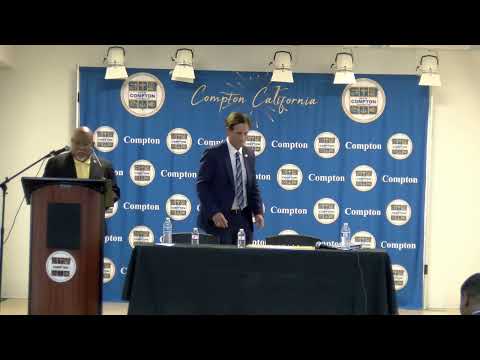
At a Compton NAACP town hall, Los Angeles County District Attorney Nathan Hutchman described how his office addresses police misconduct and wrongful convictions through dedicated units and senior-level review.
Hutchman said allegations of officer misconduct or officer‑involved shootings are handled by a Justice System Integrity team (often called the "Jason" unit in his remarks), which assigns experienced prosecutors to review body‑camera footage, surveillance, texts and reports before deciding whether to bring charges. He added that certain officer‑involved shootings go directly to the state attorney general’s office for independent review.
On wrongful convictions, Hutchman described the Justice Criminal Review Unit (J‑Crew), whose investigators and prosecutors re‑examine decades‑old cases when new evidence emerges. He gave an example in which confessions by other incarcerated people produced detail sufficient for prosecutors to conclude that two people convicted 17 years earlier were factually innocent; the office expedited their return for a judicial hearing and they were released prior to Christmas.
Hutchman framed the work as balancing respect for law‑abiding officers with intolerance for corrupt or criminal conduct, saying "if they act like a criminal, they will be prosecuted like a criminal." He also encouraged community monitoring through programs such as Compton Court Watch and offered an "open door" for community members to raise concerns with prosecutors.
When asked about safeguards against racial bias in charging, Hutchman outlined statutory and procedural tools: a racial‑justice challenge that allows defense scrutiny of charging decisions and a racially blind charging‑review process that redacts racial identifiers during initial charging decisions, with reintroduction of identifiers later and justification required for any change.
The DA invited Compton residents to engage with his office, ensured victim families would be consulted in serious cases and said the office assigns its most experienced staff to handle the most sensitive investigations.