Get Full Government Meeting Transcripts, Videos, & Alerts Forever!
Get email alerts on the Housing Affordable topic
No spam. Unsubscribe anytime.
Half Moon Bay Council Extends Negotiations on 555 Kelly Senior Farmworker Housing, Asks for Financing and Legal Clarifications
Summary
After hours of public testimony largely supporting Mercy Housing’s 555 Kelly senior farmworker project, the council voted to extend its exclusive negotiations agreement through Dec. 31, 2026, while directing staff to return with clearer financing plans, a regulatory agreement and definitions of local preference.
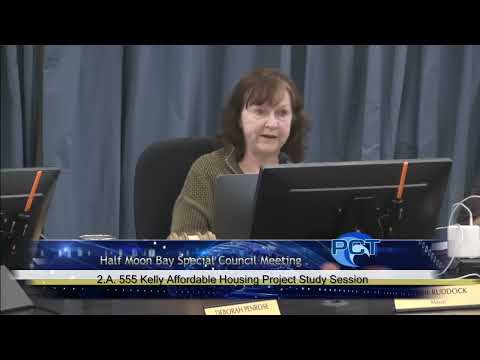
The Half Moon Bay City Council voted unanimously on April 1 to extend its exclusive negotiations agreement (ENA) with Mercy Housing for the 555 Kelly Avenue senior farmworker housing project, giving staff and the developer more time to finalize financing and legal protections after a lengthy study session and public comment period.
The extension moves the ENA deadline to Dec. 31, 2026. Council members said the extra time is intended to allow the city to receive redlined versions of the Affordable Housing and Property Disposition Agreement (AHPDA), the long-term ground lease and the still-in-progress regulatory agreement that will record affordability covenants against the property.
Why it mattered: The session produced two clear and competing pressures. Hundreds of minutes of public comment—largely from farmworkers, their families, faith groups and service providers—urged quick action so older agricultural workers can age in place. At the same time, council members pressed staff and the developer for more detailed documentation: a balanced operating pro forma, a clear list of funding sources and contingencies, precise definitions for the project’s local preference rules (for example, who qualifies as a “retired or current agricultural worker”), and explicit language addressing long-term risks such as insurance, mortgage protections and potential conflicts between the AHPDA and the ground lease.
Public testimony: Dozens of speakers told personal stories about overcrowding, long hours in physically demanding jobs, and the fear of being forced from the coast in retirement. "I am 9 years old ... I do not want them to leave just because they can't afford a place to live," said Lucy Miller, who spoke in support of the project. Faith and community organizations and service providers including Alas and Second Harvest of Silicon Valley described the development as a narrow but urgent response to a local housing shortage for an aging farmworker population.
Legal and financial questions: Interim City Attorney Denise Bazano and outside counsel Lisa Maxwell summarized major provisions in the draft AHPDA and ground lease. Key points: the AHPDA sets development and affordability obligations and is designed to terminate upon issuance of temporary or final certificates of occupancy, while the regulatory agreement (to be recorded) will preserve long-term affordability covenants. Mercy requested a 99-year ground lease at $1 per year; counsel said that length is common for tax-credit financed projects but acknowledged statutory and public-sensitivity questions about very long-term leases of city land.
Council members repeatedly asked whether Government Code Section 37380 (which governs long leases, requires an authorizing ordinance and can allow referendum) applies or whether separate statutory authority for affordable-housing transactions governs instead. Bazano said she would provide a written legal memorandum explaining the applicable code sections and their procedural implications.
Financing: Staff noted a $2 million state earmark already deposited in the city’s affordable-housing fund and recommended using a reimbursable grant agreement to preserve auditability. Mercy’s financing strategy described in the session would rely primarily on 9% low-income housing tax-credit equity, county gap financing and government-style takeout loans; council members asked for a detailed, balanced pro forma showing operating revenues, expense assumptions (including insurance and prevailing‑wage obligations), debt-service scenarios and contingencies if tax-credit awards fall short.
Community space and governance: Council members asked for clearer terms on the on-site community-serving space, including an ad-hoc committee’s expectation that the city retain 16 hours per week for public use. They also objected to blanket delegation of broad decision-making authority to the community-development director; several members asked that higher-level review (city manager or council) be required for material financing, mortgage or management changes.
What’s next: Staff and Mercy agreed to return with redlines, a draft regulatory agreement, a more detailed financing plan and a clearer sublease for the community‑serving space. The council’s extension gives the city and Mercy time to complete that work and to preserve Mercy’s eligibility for upcoming funding rounds. The ENA extension does not itself bind the council to the lease or to final project approvals.
The council voted 4–0 to extend the ENA to Dec. 31, 2026; Council Member Brownstone moved the amended extension and the motion carried on roll call (Brownstone, Nagingghast, Penrose and Mayor Reick voted yes).