Get Full Government Meeting Transcripts, Videos, & Alerts Forever!
Get email alerts on the Housing Plan Eir topic
No spam. Unsubscribe anytime.
Planning Commission reviews draft Housing Plan program EIR; staff, consultant outline mitigations for assumed 8,001-unit need
Summary
City staff and Rincon Consultants presented the draft Housing Plan program EIR, which assumes construction of 8,001 units by 2035 and identifies programmatic mitigation measures (air quality, biological resources, cultural resources, noise, hazards). Commissioners sought clearer timelines, protocols for undiscovered underground storage tanks, and more analysis or council guidance if the city pursues an expanded alternative up to ~8,800 units.
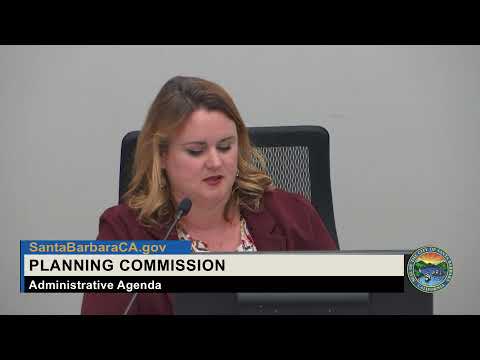
The Santa Barbara Planning Commission on March 12, 2026 held a public hearing on the draft Housing Plan Program Environmental Impact Report (EIR), hearing a city staff presentation and a consultant summary of program-level impacts and mitigation measures. Julia Puccio, the city's environmental analyst and the assigned planner for the draft program EIR, told the commission the analysis assumes the construction of 8,001 new housing units by 2035, describing that figure as the city's housing need.
Rincon Consultants' Chris Burschback summarized the programmatic approach and emphasized coordination with city staff on the EIR and related Master Environmental Assessment (MEA) guidelines. He said the program EIR evaluates citywide, high-level impacts and identifies programmatic mitigation and standard conditions that can be applied to future projects to reduce environmental effects.
The draft EIR finds most topic areas would be less than significant at the program level when mitigation and existing regulations are applied; it identifies targeted mitigation in sections that require additional protections. Those measures include construction-era air-quality controls aligned with the Santa Barbara Air Pollution Control District, biological protections (riparian buffers, pre-construction surveys, oak-woodland protections), tribal-cultural and archaeological discovery protocols, construction-noise and vibration plans, and environmental-site-assessment triggers where contaminated soils or documented leaking underground storage tanks (USTs) could be present.
The document also analyzes alternatives. The statutorily required No Project alternative would not implement the housing plan and therefore would not meet the city's Regional Housing Needs Allocation (RHNA) obligation, the staff summary said. A second, conceptual expanded-housing alternative was analyzed to show environmental consequences of up to about 8,800 units; the consultant reported that the proposed housing plan (the project) is identified in the draft EIR as the environmentally superior option because it balances production with mitigation.
Public comment at the hearing was limited to one virtual participant. Steve Johnson told the commission, "the number of moderate-income market-rate units produced since 2023 is zero. That's the same number that have been produced in the last 45 years," and urged staff and the commission to address perceived zoning bias against moderate-income market-rate housing.
Commissioners focused their questions on implementation and the EIR's practical reach: Commissioner Wiskum asked whether the EIR sets deadlines for mitigation measures and who will be responsible for monitoring; staff said a mitigation monitoring plan will be prepared with timeframes and assignment of responsibilities. Wiskum and other commissioners also asked the EIR team to add clear protocols in the EIR for encountering previously undiscovered underground storage tanks in older downtown building sites; staff said the hazards chapter uses a screening layer for documented USTs and that development in identified downtown areas could trigger a Phase I environmental site assessment and remediation procedures.
Several commissioners pressed the consultants on how ministerial exemptions and recent state law changes (for example, projects qualifying for SB 130 ministerial review) interact with programmatic protections. Staff responded that where projects are exempt from project-level CEQA review, the city can still apply uniform standard conditions and ordinance updates to protect resources, and the EIR's mitigation measures are intended to be carried forward as standard conditions and MEA guideline updates.
Commissioner Balkey questioned whether the incremental addition of units in the expanded alternative (roughly an additional ~800 units beyond the 8,001 baseline) realistically produces the significant air-quality and greenhouse-gas findings the draft EIR records, and urged a more rigorous alternatives analysis so the City Council would have clear choices. The consultant replied that screening against adopted regional air-quality plans can produce inconsistency determinations even for modest numeric deltas and suggested that if the council wanted to pursue the expanded alternative the most straightforward route could be a council-level overriding-considerations finding.
Commissioner Barnwell offered numerous editorial and policy comments, asking staff to clarify implementation timelines, tighten discussion of impacts (for example, how the report treats surface parking, commercial/residential mixed-zoning, and transportation assumptions), and call out regional constraints such as the Tajiguas Landfill closure date and school-district fiscal limits. Several commissioners asked staff to reflect those specific clarifications in the final EIR.
Next steps: staff said the public review period for the draft program EIR closes on March 17, 2026; Rincon and city staff will prepare written responses to comments and deliver a final program EIR package to the City Council for certification, CEQA findings, and adoption of mitigation measures and any implementing ordinance amendments. No formal project approvals or council actions were taken at the March 12 hearing.
The commission asked staff to consider the following edits or additions to the draft EIR before finalization: (1) explicit protocols and screening procedures for previously undiscovered USTs and contaminated-site discovery during construction, (2) clearer mitigation-monitoring timelines and assignments, and (3) clarification or additional analysis of consequences and mitigation if the city advances an expanded alternative exceeding the EIR's 8,001-unit baseline.