Get Full Government Meeting Transcripts, Videos, & Alerts Forever!
Get email alerts on the Zoning Text Amendment topic
No spam. Unsubscribe anytime.
Los Ranchos planning commission backs text amendments to consolidate definitions and rewrite sign rules
Summary
The Planning & Zoning Commission voted April 8 to recommend TA-25-01, a package of zoning code edits that consolidates definitions, updates transfer-of-development-rights language and revises sign rules to meet First Amendment (content-neutral) standards; commissioners approved several edits and asked staff to return with follow-up on billboard amortization and other details.
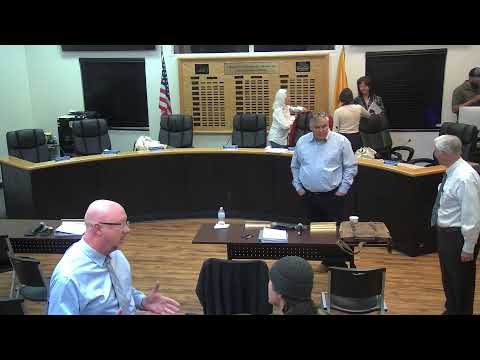
The Planning & Zoning Commission of the Village of Los Ranchos de Albuquerque voted April 8 to recommend approval of TA-25-01, a text amendment to the village’s comprehensive zoning code that consolidates scattered definitions into a single section and revises sign regulations to be content-neutral and constitutionally compliant.
Brennan Williams, a private consultant presenting the package on behalf of the village administrator, told commissioners the proposal is a legislative cleanup that relocates duplicate or unused defined terms into section 9.2.3 and updates subsections for transfer-of-development-rights (9.2.6), the Gateway District (9.2.13), the Village Center zone (9.2.14) and signage rules (9.2.22). "This is a legislative matter," Williams said, and the two-step process would return the commission’s recommendation to the Board of Trustees for a final public hearing.
Why it matters: staff said consolidating definitions improves clarity for applicants and staff and reduces internal inconsistencies that can hamper plan review. Separately, the sign changes are intended to remove content-based categories (for example, separate rules for political signs) and instead regulate signs by neutral criteria — size, height, placement, illumination and duration — in order to conform to U.S. Supreme Court guidance on free-speech protections.
Key votes and edits - Commission recommendation: After a page-by-page review and multiple motions, the commission voted to forward TA-25-01 to the Board of Trustees with the commission’s modifications. The recommendation will allow the Board to hold its own public hearing and consider final adoption. - Billboards and "off-premise" signs: Commissioners added clarifying language to the proposed "billboard" definition to list examples ("items including but not limited to goods, merchandise, entertainment or services") and asked staff to research prior amortization dates and enforcement options for existing billboards that had been covered by earlier ordinances. Staff acknowledged that prior amortization language (with a 2011 deadline appearing in older code) may still exist in the codified record and said the village needs to confirm the legal and enforcement status. - Sandwich/A-frame signs and sidewalks: The commission directed that sandwich-board signs must not block public rights-of-way (explicitly including public sidewalks), and it adopted a sizing clarification: sandwich-board signs should not exceed 12 square feet per face. Commissioners emphasized that placement rules must protect pedestrian circulation and ADA access. - Temporary signs: The commission settled on a time-limited approach for temporary sign permits (the package records an initial period with a staff-extension option). During debate the commission set an initial temporary-permit period of 60 days with the possibility of a 30-day extension under streamlined administrative review. - Definitions clean-up and duplications: Commissioners removed a redundant "multi-residential unit" definition after cross-checking an equivalent entry under the "dwelling" heading. They also corrected terminology in the TDR section (changing "tradable" to "transferable" development rights) and restored two definitions ("performance bond" and "performance guarantee") that staff had inadvertently dropped in the redline. - Mural and content concerns: Commissioners discussed murals and visual artwork; the commission decided to retain a definition for "mural" and to treat murals within the sign framework so they are subject to size and location standards rather than being regulated by content.
What commissioners pressed staff to return with - Billboard amortization and enforcement: commissioners asked staff and legal counsel to research the village’s prior amortization schedules and the practical enforcement path for legacy billboards (including any amortization deadlines or amortization-economics calculations) and to return with recommended next steps. - Cross-references and harmonization: commissioners flagged several cross-reference fixes (for example, where removed terms must be relocated or where definitions need consistent wording across zones) and asked staff to bring tightened language when the sign ordinance and other code sections are reviewed in more detail.
Public comment Two members of the public spoke during the comment period. Teresa Riyle invited the public to the village community yard sale at Alfredo Garcia Barn on April 27 and noted proceeds benefit the village lavender festival. Vincent Sanchez told the commission he has been trying for more than a year to get answers on a personal zoning matter and asked why the village’s communication has stalled.
Next steps and closing With the commission’s recommendation in hand, TA-25-01 will go to the Board of Trustees for its public hearing and final decision. Staff will research the outstanding legal and enforcement questions (notably the billboard amortization history) and return with proposed language or options where the commission asked for clarification. The commission closed its public hearing and adjourned at about 10:10 p.m.
Attribution: Quotes and on-the-record explanations in this article are drawn directly from the hearing transcript and are attributed to the speakers listed in the commission record.