Get Full Government Meeting Transcripts, Videos, & Alerts Forever!
Get email alerts on the Ab48 Reports topic
No spam. Unsubscribe anytime.
Commission study session finds SAPD AB48 summaries meet statutory minimums but lack detail; commissioners press for clearer policies
Summary
Oversight staff told the commission SAPD's AB48 summaries satisfy statutory elements but often use vague, cut‑and‑paste language; commissioners pressed for attachments from use‑of‑force reports, clearer authorizations for tear gas, and policy changes to improve transparency.
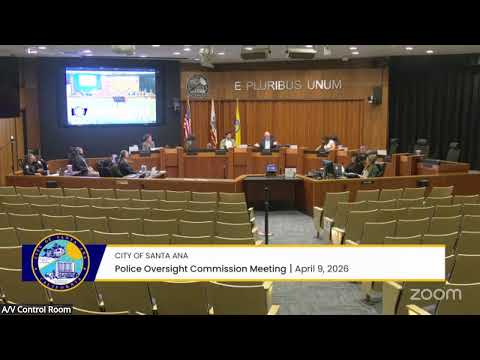
At a lengthy April 9 study session the Police Oversight Commission reviewed Assembly Bill 48 requirements, SAPD AB48 summaries for crowd‑control incidents, and related SAPD policies. Oversight staff concluded that SAPD had published AB48 summaries that included the statute's required elements but recommended adding more factual detail and clearer policy language to make the summaries useful to outside reviewers and the public.
Oversight Director Morse reviewed AB48 definitions for kinetic energy projectiles (KPs) and chemical agents and the statute's limits: KPs/chemical agents may not be used to disperse assemblies unless objectively reasonable to defend against a threat of death or serious bodily injury, officers attempt de‑escalation when reasonable, warnings are given when feasible, and an incident commander must authorize tear gas deployments.
Morse summarized five SAPD AB48 summaries for 2025 crowd‑control events, including a February 1 report and multiple June incidents tied to anti‑ICE protests in downtown Santa Ana. The June reports recorded large crowds and multiple agencies on scene and listed deployments that included dozens to more than a hundred 40mm rounds and several canisters of CS gas on different days. Morse said each SAPD summary contained the statutory checklist but frequently used ‘‘targeted assaults’’ or similar conclusory phrasing without incident‑level facts (for example, which specific projectiles were thrown, how many, and which individual deployments correspond to each use‑of‑force report). He flagged repeated cut‑and‑paste language across June reports and questioned what a commander's signature attests to (completion versus factual verification).
Commissioners pressed staff on several issues: how injuries are counted and whether they include officers; whether AB48 summaries should explicitly link to underlying use‑of‑force reports and body‑worn camera footage; whether SAPD or assisting agencies file separate AB48 summaries; whether SWAT commander authorization and incident‑commander approval are consistently recorded; and the public‑health impacts of CS tear gas (several commissioners asked staff to examine reproductive‑health and other effects).
Morse recommended practical changes: include attachments or a brief appendix drawing directly from use‑of‑force reports (e.g., a spreadsheet with incident‑by‑incident mappings of thrown objects and the round(s) fired), expand narratives about de‑escalation efforts, clarify the meaning of the commander signature, ensure cross‑references among SAPD policies (429, 303 and procedure 3004), and consider using the allowed reporting window (up to 90 days when justified) to improve accuracy. He also recommended clarifying which roles (watch commander, incident commander, SWAT commander) may authorize particular tools and aligning policy language so that it is internally consistent.
Several commissioners said they want the item returned for a future meeting with potential policy recommendations and a process for notifying the commission when agencies post AB48 summaries. Director Morse said SAPD's current practice is to post summaries on its website and to compile AB48 summaries after reviewing use‑of‑force documentation; the department's representative said commander signatures indicate a verification that the summary reflects facts known at the time.