Get Full Government Meeting Transcripts, Videos, & Alerts Forever!
Get email alerts on the Charter Revision topic
No spam. Unsubscribe anytime.
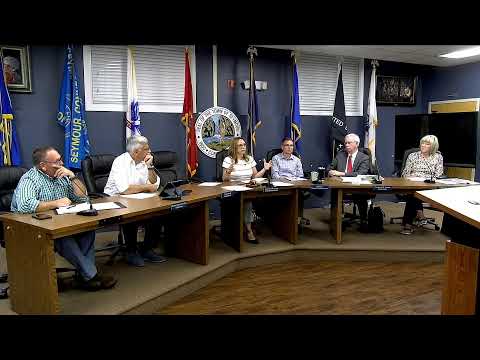
Seymour board accepts charter commission’s final report, sends charter questions to November ballot
Summary
The Board of Select Persons accepted the Charter Revision Commission’s final report and voted unanimously to place multiple charter amendments — including changes to the budget process, special town-meeting thresholds, and gender-neutral titles — on the Nov. 4, 2025 ballot after clarifying question wording and statutory deadlines.
The Seymour Board of Select Persons voted to accept the Charter Revision Commission’s final report and to place a set of proposed charter amendments on the Nov. 4, 2025 municipal ballot.
Tom Gardell, chairman of the Charter Revision Commission, told the board the commission worked since November 2024, held multiple public hearings and produced a redlined final report that removed a previously proposed shared-services recommendation and made four principal changes from the draft: deleting the shared-services proposal, adding town-meeting authority to increase proposed appropriations, modifying treasurer qualification language to allow appointing-official discretion, and replacing gendered references ("first select man/woman") with "first select person." "There is no longer a recommendation by the commission for shared services — it is gone," Gardell said.
Why it matters: the board’s votes will place several separate questions before the town’s voters this fall and set a procedural timeline that local officials must meet. Legal counsel reminded members that the board must set an election date by Sept. 5, notify the Secretary of State by Sept. 20, and publish the ballot questions by Oct. 2 if the board proceeds on the ordinary timeline.
Public comment and concerns: Kristen Harmon, a 13-year member of the Board of Education, urged caution about inserting detailed calendar dates into the charter. She praised elements of the commission’s work — including combining the parks and recreation commissions and appending the board of education budget to the town budget — but said locking referendum dates and tight two-week turnaround expectations would hamper the education budget and contractual negotiations. "I just don't think those are needed," Harmon said, asking the board to avoid micromanaging the budget process with fixed dates and to help explain the practical limits of rapid changes to voters.
Votes at a glance (board action at meeting): - Accepted Charter Revision Commission final report — outcome: approved (motion carried 6-0). - Section 14.3 (budget process; allow town meeting to increase appropriations) — approved (6-0). - Increase special town-meeting threshold from $100,000 to $150,000 — approved (6-0). - Combine Parks Commission and Recreation Commission — approved (6-0). - Require first select person to develop multi-year strategic plan — approved (6-0). - Modify treasurer education/training requirements (granting discretion to appointing official) — approved (6-0). - Replace gendered office titles with "first select person" — approved (6-0). - Technical corrections, grammar and statutory reference updates — approved (6-0).
Next steps: The board approved language changes and split a previously confusing dual-element question into two separate ballot questions (one addressing the town-meeting power to increase appropriations and one addressing clarification of budget procedures and required submission dates). The board set Nov. 4, 2025 as the election date for the proposed charter amendments and confirmed polling hours and locations; staff were directed to comply with the statutory calendar for publication and Secretary of State notification.
Procedural note: Select persons repeatedly emphasized that, under state law and the commission process, the board's role is to accept or reject the commission's report and not to edit the commission's text. Several members also noted they had not received the final redlined document before the meeting and asked staff to circulate the final report to ensure transparency before voters review the questions.
What did not change: The commission removed the shared-services recommendation from the final report; it also retained the town meeting as a forum for discussion and machine vote rather than eliminating that institution.
The board’s acceptance of the final report and the decision to place the questions on the ballot concludes the commission’s work; the town will now proceed with statutory steps to notify the Secretary of State and publish the ballot language.